

Desktop 64 Channel picoTDC unit for FERS-5200
DT5203
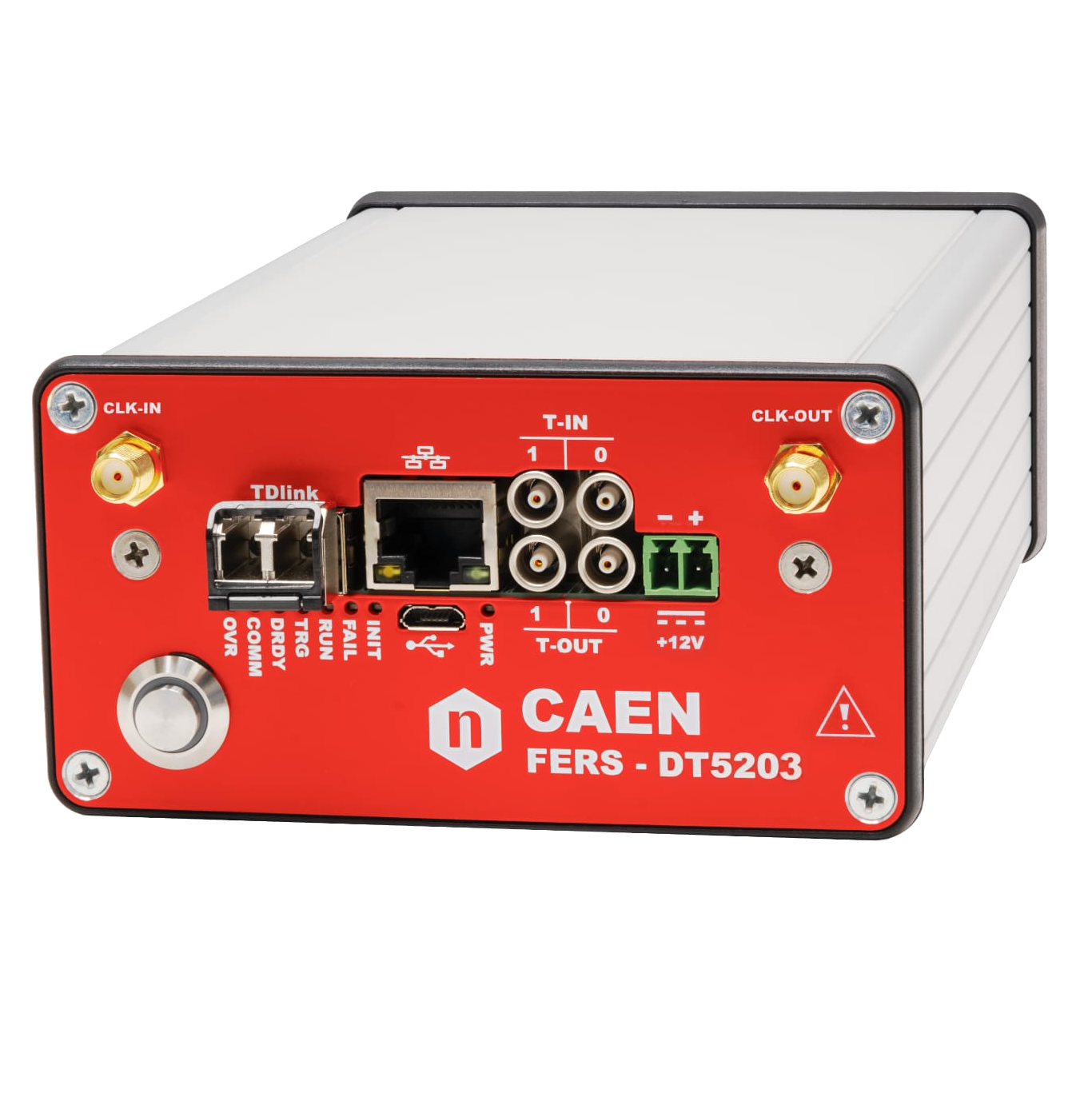
FERS-5200 is a front‐end readout system designed for the readout of large detector arrays, such as SiPMs, multi‐anode PMTs, Silicon Strip detectors, Wire Chambers, GEMs, Gas Tubes and others. FERS‐5200 is a distributed and scalable system, where each unit is a small card that houses 64 or 128 channels. It features a detector specific Front-End interfaced to a common infrastructure that guarantees readout interfaces, slow control and synchronization. Typically, the front-end is based on ASIC chips that allow for high density, cost effective integration of multi-channel readout electronics into small size and low power modules. FERS is a flexible platform: combining the same back-end (i.e. readout architecture and interface) with different types of front-end to fit a wide range of detectors.
The DT5203 (and A5203, which is the naked version), part of the FERS-5200 family, is a Time-to-Digital Converter for high-resolution multi-hit time measurements that bases its functionality on the picoTDC chip (produced by CERN). The A5203B houses an additional mezzanine card with a second picoTDC chip, thus implementing a 128 channel TDC module.
Each readout channel accepts LVDS signals and measures the time stamp of both rising and falling edges with an LSB of 3.125 ps. In this way, the unit is able to reconstruct Time of Arrival (ToA) of signals as an absolute timestamp or as a ΔT with respect to a common Tref pulse. The picoTDC can also acquire Time over Threshold (ToT) information and combine it with the edge time stamp. The ToT allows for amplitude estimation, energy spectrum reconstruction, and timing walk correction. The latter permits to achieve optimal timing resolution with no need of Constant Fraction Discriminators.
The A5203 supports Common Start, Common Stop, Trigger Matching and Streaming acquisition modes. Have a look at FAQ for more details.
For small setups a single DT5203 unit can be used stand alone, without any additional hardware, by simply connecting the unit to a PC via USB 2.0 or Ethernet 10/100T. For large readout systems, a flexible and scalable network of units can be created by means of the high speed optical link called TDlink that allows up to 16 FERS‐5200 units to be connected in daisy chain (ring) providing data readout, synchronization between the units and broadcasting of commands (e.g. triggers, time resets, etc.). The DT5215 is a data collector board (FERS‐CB) housing 8 TDlink masters that will make it possible to manage up to 128 FERS‐5200 units.
The DT5203 is fully supported by the CAEN Janus 5203 Open Source software on Windows® and Linux®. Janus can run in console mode (C program, without graphics) or connected to a GUI written in Python. The GUI has configuration and run control panels that simplify the data acquisition management. Both console and GUI modes permits to acquire data from multiple boards, manage the event building and timing histograms (ToA and/or ToT), display data statistics (hit rate, throughput, etc…), plot histograms, and save output, including spectra and list files with the acquired timing data.
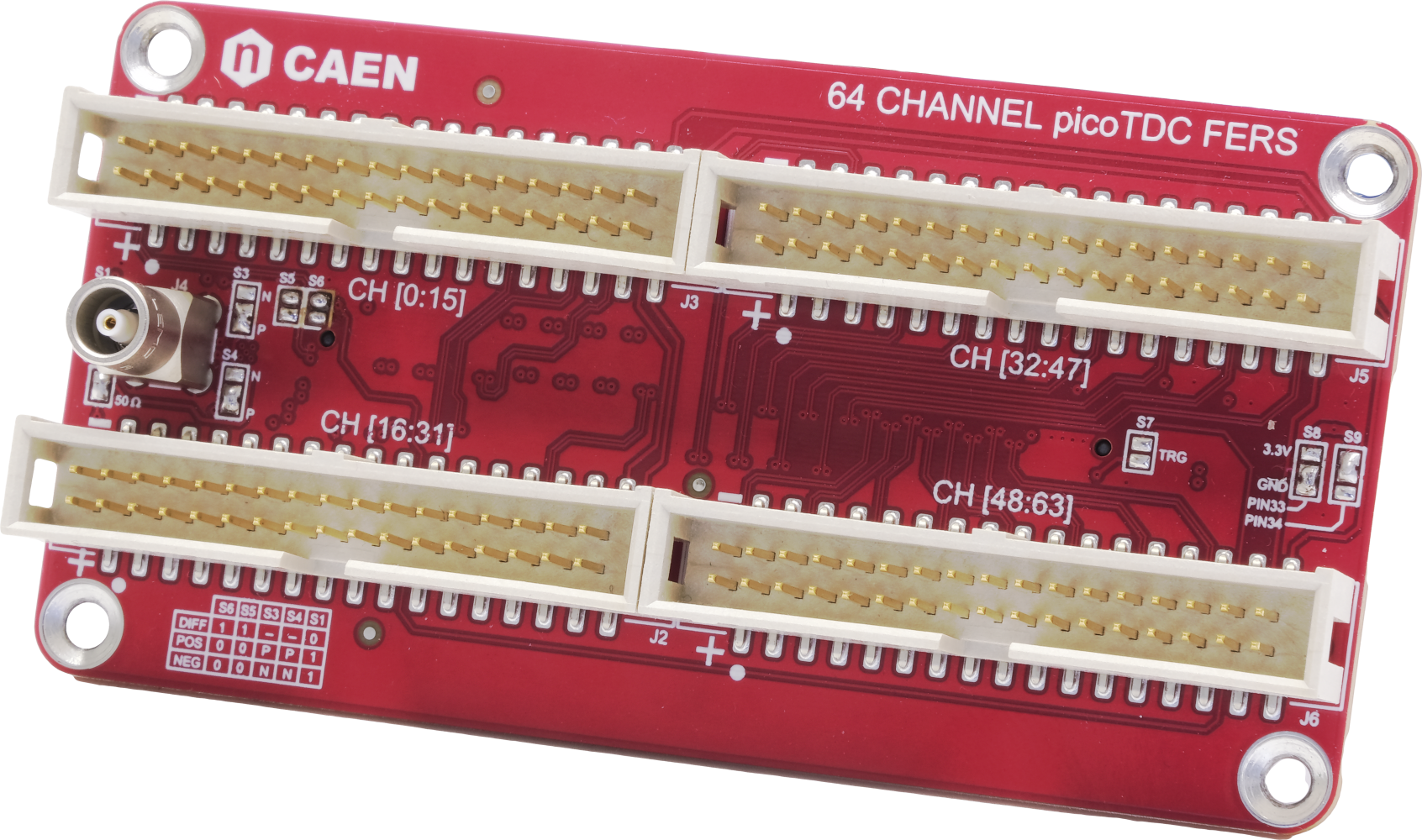
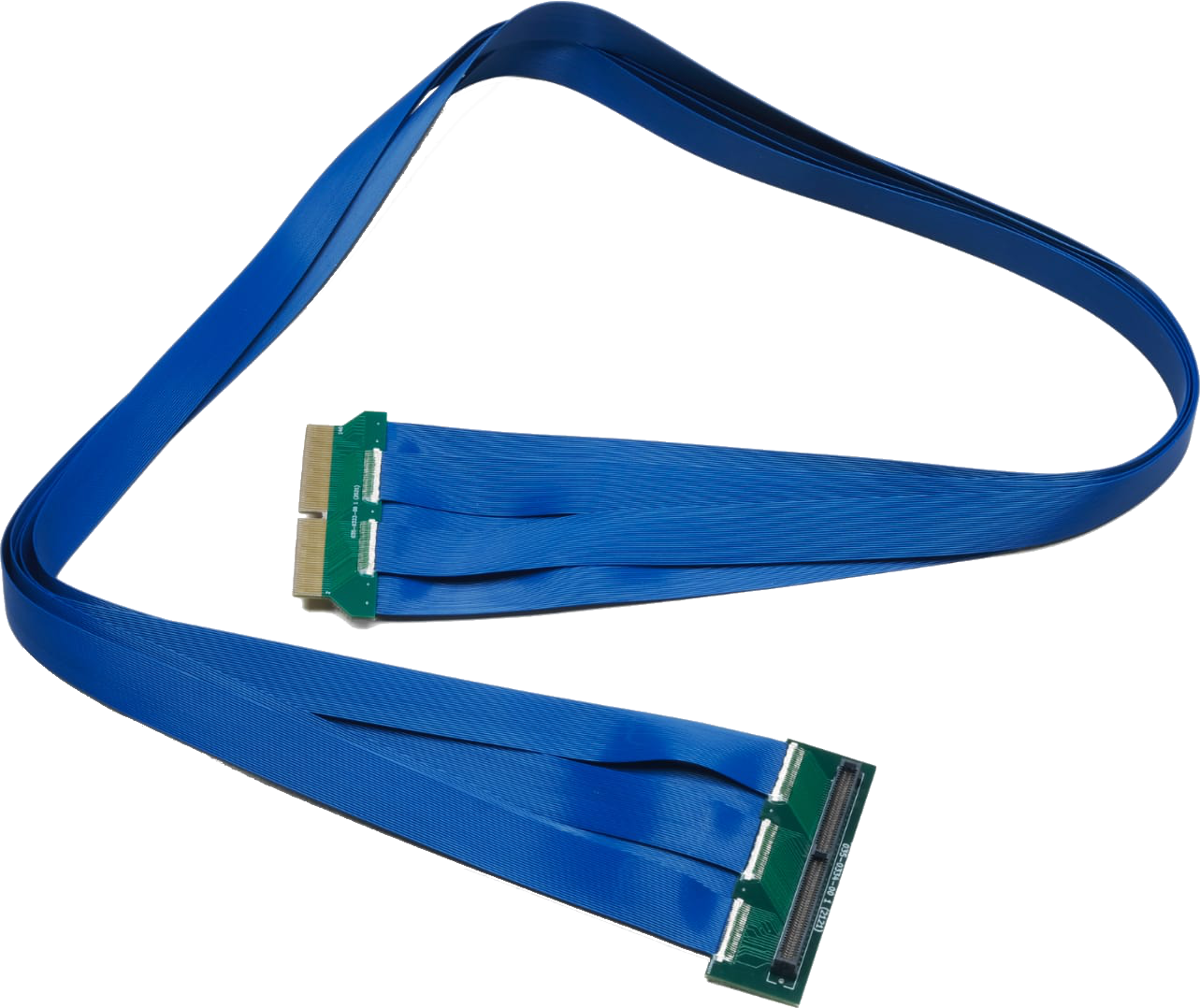
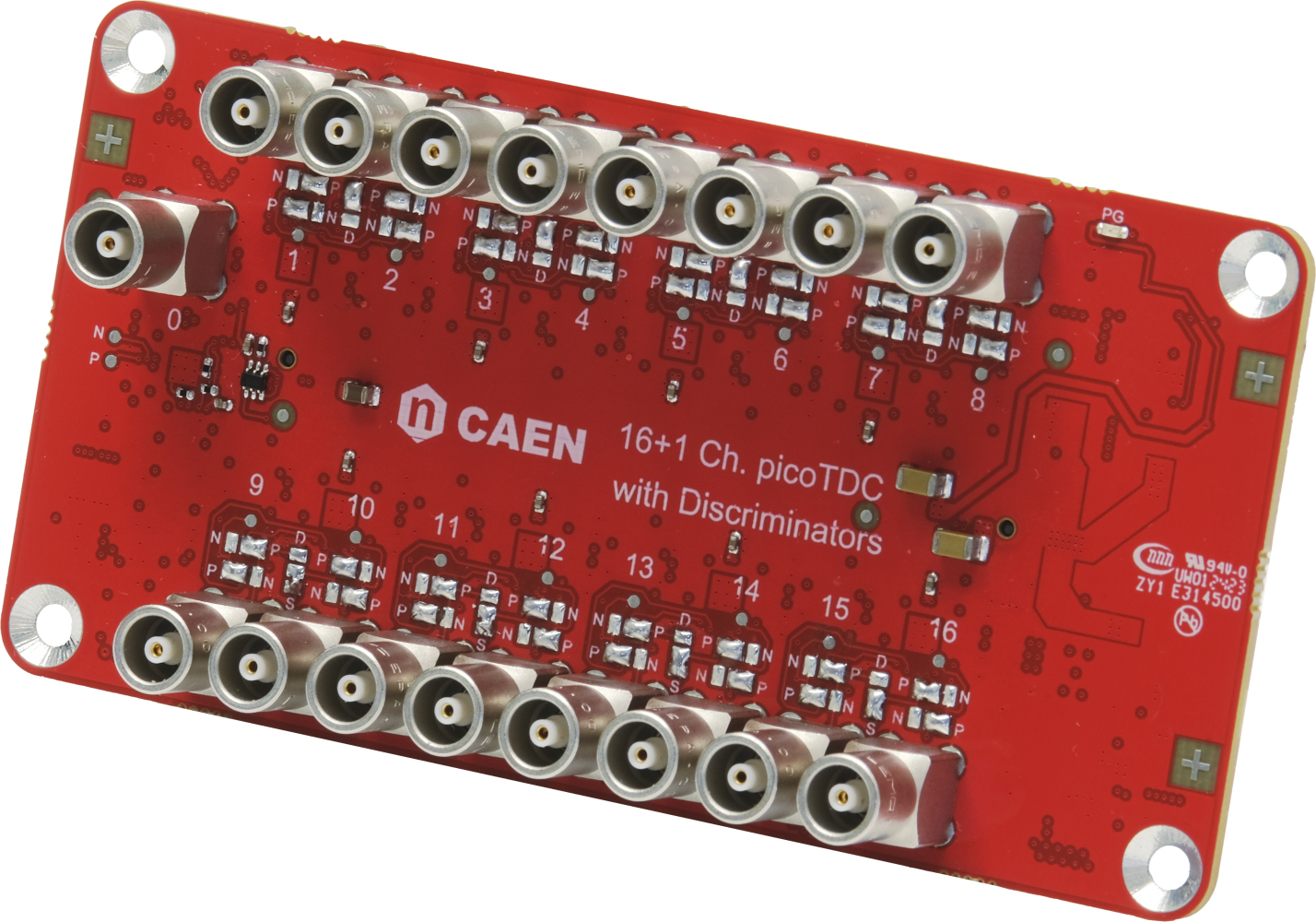
A wide range of adapters and cables has been also specifically designed for FERS-5200 boards, in order to provide versatility of choice and the ability to remotely operate the detectors, a complete list is available here. The A5255 adapter is standardly mounted as rear panel of the DT5202. An alternative compatible adapter may be installed upon customer request.
Features
-
64-ch TDC unit for high-resolution timing applications housing the CERN picoTDC
-
Part of FERS-5200, the CAEN platform for the readout of large arrays of detectors (SiPM, MA-PMTs, Gas Tubes, Si detectors, …)
-
Timing resolution: LSB = 3.125 ps, RMS typ. ∼ 7 ps
-
TDC dynamic range: up to 26 bit (∼ 210 μs). Extendable to 56 bit in the FPGA
-
Inputs: differential LVDS signals (max common mode = 1.2 V; max absolute voltage = 1.45 V). NIM, TTL or analog signals through dedicated adapters
-
Acquisition of leading/trailing edge Time of Arrival (ToA), or leading edge ToA plus Time over Threshold (ToT) of the input signals
-
Scalability and easy-synch: up to 128 cards (8192 channels) can be managed and synchronized by a single DT5215 Concentrator Board, thanks to the optical TDLink
-
Janus 5203 open source software available for board and DAQ control
-
Flexibility: a full range of adapters and cables for different kind of applications and sensors remotization
-
Naked unit available (A5203) for customizable mechanical frames
DT5203: Data Sheets

DT5203: Manuals
DT5203: Download
Presentations
Brochures / Flyers
Driver
Applications SW
Request a Quote

Footer