

16 Channel 14 bit 1 GS/s Digitizer with programmable Input Gain
DT2751
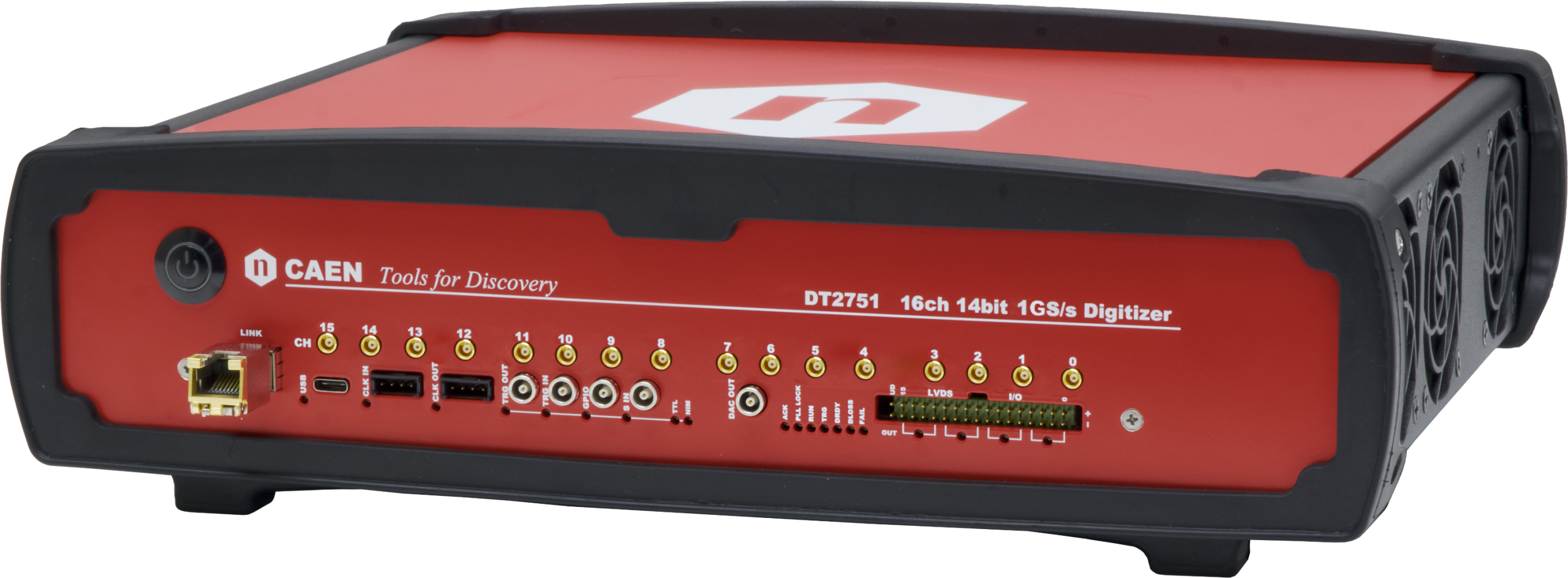
The DT2751 Digitizer is a 16-channel digital signal processor for radiation detectors in a Desktop form factor. It offers not only waveform digitization and recording but also Multi-Channel Analysis for a complete range of applications like nuclear and particle physics, high-timing resolution, Fast Neutron Spectroscopy, and Homeland Security. It is compliant with fast signals typically coming from organic, inorganic, and liquid scintillators coupled to PMTs or SiPMs, as well as Diamond detectors.
The DT2751 can perform different types of signal processing, basing on algorithms like charge integration and pulse shape discrimination (PSD), constant fraction timing (CFD), and zero-length encoding (ZLE). The algorithm parameters can be set individually for each channel or globally for all channels on the board.
Each channel of the module digitizes the analog input, which can be the signal coming from a physics detector, with a 14-bit 1GS/s ADC. The sampled data are used to initiate the digital pulse processing sequence, managed in the FPGA at the firmware level. Different firmware types can be stored at once on-board and then selected via software, according to the specific setup and acquisition mode.
-
Common trigger: All channels acquire simultaneously with a common trigger. The trigger can be fed externally or generated by a combination of individual channel discriminators. This mode is mainly intended for the acquisition of waveforms, like a digital oscilloscope. Options for zero suppression are available to remove not significant data.
-
Independent trigger: Suited mode for trigger-less applications, where no global trigger is needed but each channel acquires waveforms upon its self-trigger which fires through a digital discriminator, independently of the others.
-
DPP: Real-time processing in the FPGA allows for the extraction of physical parameters from the waveform (e.g. charge, timestamp, PSD), well suited for high counting rate applications. It is yet possible to save both raw waves and parameters.
CAEN provides closed firmware solutions for Scope (waveforms) and DPP modes, as well as a firmware generation and compiling tool for customers who want to personalize the acquisition to implement custom algorithms for pulse processing in the open FPGA. The user can have control of the data output information and customize the trigger logic to get several combinations of self-triggers and I/O signals to validate or discard the events. The Linux-based Arm processor embedded in the onboard CPU makes it possible to run automated user routines. Multi-board synchronization can be implemented via backplane or front panel easy-cabling options. Multiple communication interfaces offer flexible readout options: USB 3.0 type-C and 1/10 Gigabit Ethernet or optional Optical (CONET – CAEN Daisy Chainable Optical Link Protocol) Links.
Features
-
14 bit @ 1 GS/s ADC
-
16 single-ended analog inputs on MCX connectors
-
2Vpp input range with software selectable analog gain
-
Open FPGA programming through the graphical tool Sci-Compiler
-
Wide range of applications (from Nuclear and Particle Physics to High Timing Resolution, Fast Neutron Spectroscopy, Dark Matter and Astroparticle, Fusion Plasma diagnostic, and Homeland Security)
-
Suited for signals from fast organic, inorganic and liquid scintillators coupled to PMTs or SiPMs, Diamond detectors and others
-
On-board live selection between scope mode (common trigger) and DPP mode (independent channel self-trigger)
-
Rack mount brackets included
-
Multiboard Synchronization and system-building capabilities
-
Front panel fully programmable I/Os (4 LEMO TTL/NIM and 16 LVDS)
-
Special 125MS/s 14-bit DAC output (LEMO) for signal inspection or trigger sum
-
On-board Zynq® UltraScale+™ FPGA with embedded Linux-based ARM® processor
-
5GB of total acquisition memory (DDR4)
-
USB-3.0 type-C and 1/10 Gigabit Ethernet or optional CONET (CAEN daisy chainable Optical Link protocol) interfaces
-
SDK for embedded Linux processor and host PC
DT2751: Data Sheets

DT2751: Manuals
DT2751: Download
Guides
Brochures / Flyers
Driver
Applications SW
Request a Quote

Footer