

32 Channel SiPM Readout Board for Cosmic Rays Veto BOXED
DT5702
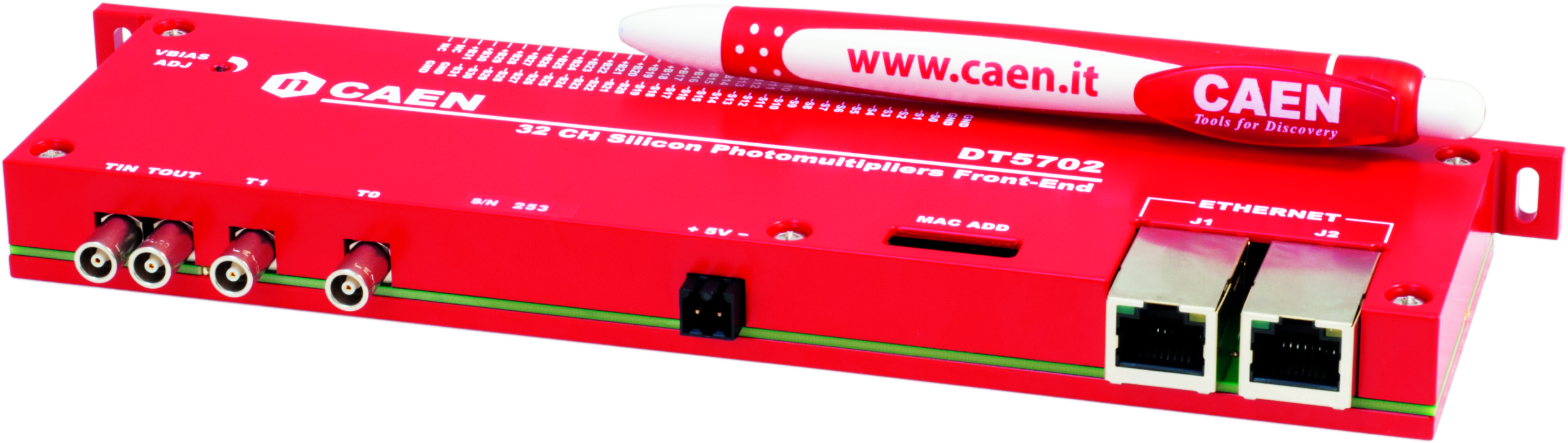
The CAEN Mod. DT5702 is the desktop version of the A1702. It is a custom design developed by the Albert Einstein Center for Fundamental Physics of the University of Bern for the readout of SiPM arrays used in the Cosmic Rays veto of Liquid Argon Neutrino Experiments. The board is designed for the exact purpose of detecting coincidences at the far ends of scintillating fibers coupled with SiPMs and measure the signal energy as well as the time of arrival for track reconstruction.
The analog input signal is processed by CITIROC, a 32-channel ASIC from WeeROC. Each channel is made of a high-gain charge preamplifier (x 10 – x 600 gain range), fast shaping with the peaking time of 15 ns and slow shaping with configurable shaping time in the range of 12.5 ns to 87.5 ns. Signals from the fast shapers are discriminated (programmable threshold) and produce digital signals (T0-T31) for event triggering. These signals are then combined in the FPGA to give coincidence triggers. The input signals height can be stored in the ASIC Sample-and-Hold (S/H) circuit and multiplexed to a single analog output. This output is routed to an external ADC for sampling and energy list decoding.
The board allows to perform timing measurements, thanks to external reference signals to be fed at the dedicated LEMO inputs. Using very stable signals, like PPS pulses, it is possible to reach timing resolution down to 1 ns. Additional T-IN/T-OUT connectors for board-to-board trigger validation are also available.
The board communicates with the host computer through Ethernet protocol, relying on a ROOT-based demo software running on Linux.
Features
- Readout board for SiPM, tailored for Cosmic Rays Veto systems in Neutrino experiments.
- Based on 32-channels WeeROC CITIROC ASIC
- Coincidence of signals from each pair of adjacent even-odd channels
- Provides bias voltage in the range of 20-90 V, individually adjustable for each of 32 SiPMs
- Amplification and shaping of the SiPMs output pulse on each of 32 channels
- Discrimination of shaped signal at configurable level from 0 to 50 SiPMs photo-electrons
- Timing resolution down to 1 ns with stable external reference signals
- Readout via 100 Mbps Ethernet, double ports for multiboard daisy-chain
- ROOT-based readout software
DT5702: Manuals

DT5702: Download
Articles
Brochures / Flyers
Applications SW
Request a Quote

Footer