

Concentrator Board for FERS-5200
DT5215
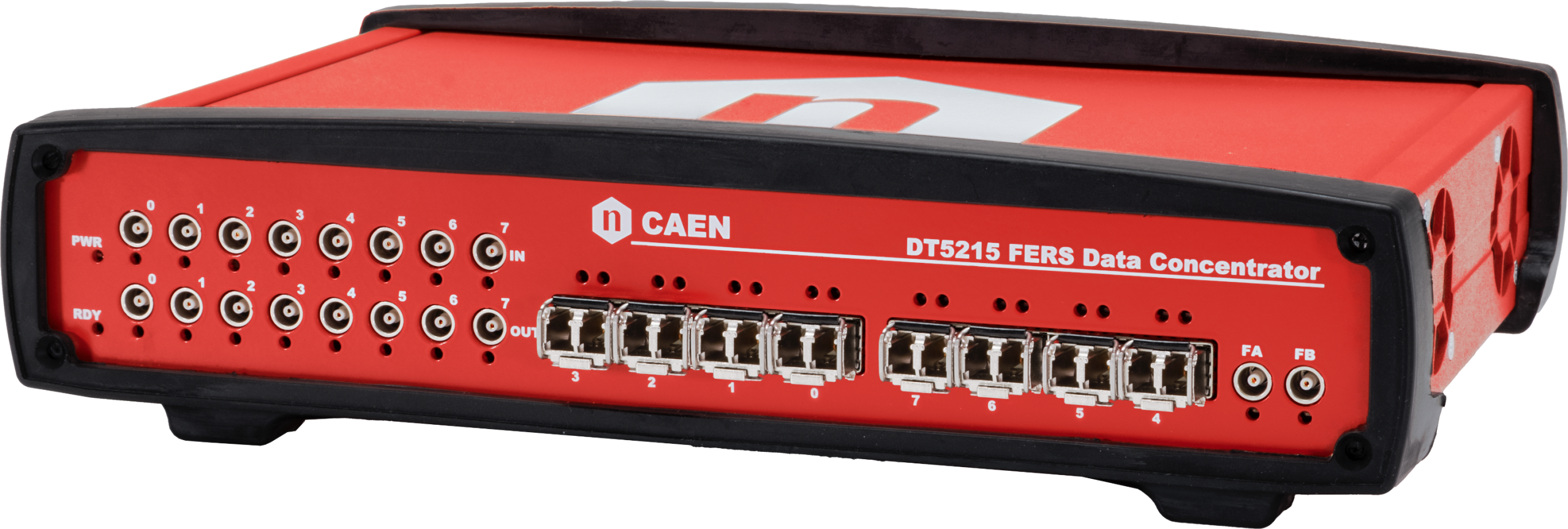
FERS-5200 is a Front-End Readout System designed for large detector arrays, such as SiPMs, multi-anode PMTs, Silicon Strip detectors, Wire Chambers, GEM, Gas Tubes and others.
FERS is a distributed and easy-scalable platform, where each unit is a small card that houses 32 or 64 channels with Front End electronics, A/D converters, trigger logic, synchronization, local memory and readout interface.
FERS is a flexible platform: keeping the same readout and control infrastructure, that is the same user interface, different types of front-end can be developed to fit a variety of detectors. In most cases, the front-end is based on ASIC chips that allow for high density, cost-effective integration of multi-channel readout electronics into small size and low power modules. The Front End ASIC can implement an analog chain made of preamplifier, shaper, peak sensing and discriminator. In other cases, the ASIC is a fast flash ADC (1 GS/s or more) that records the waveform of the input pulses and makes it possible to apply digital algorithms providing timing, energy and pulse shape information.
One FERS unit can be used stand alone, without any additional hardware, just connected to the computer via USB 2.0 or Ethernet 10/100T. This is a cheap and an easy-to-use evaluation board of the specific ASIC chip housed on the FERS unit. Once the solution is validated, scaling up to thousands channels is immediate: multiple FERS units can be connected in a tree network, where the optical TDlink is the unique physical connection that guarantees high throughput data readout, slow control and accurate timing synchronization.
One DT5215 (FERS Data Concentrator) can manage up to 8 TDlinks, each connected to 16 FERS units in daisy chain: in the case of the A5202/A5203 FERS unit, it makes 8192 readout channels. The Data Concentrator is connected to the Host computer through 1 Gb Ethernet (10 GbE Coming Soon) or USB 3.0. Multiple concentrator boards can be synchronized in order to further extend the total number of channels (Coming Soon).
A Linux-based Single Board Computer is embedded in the Concentrator board. It manages the data readout from the network of FERS units and the event data building according to the time stamp and/or trigger ID of the event fragments acquired by each unit. Sorted and merged data packets are then stored to the local memory and finally sent to the host computers through a fast 1 Gb Ethernet (10 GbE Coming Soon) or USB 3.0 link. Custom algorithms for data processing and reduction can be easily uploaded by the user into the embedded CPU.
One computer, one Concentrator, thousands of channels
FERS-5200 is an extendable system: the same FERS unit can be used either as stand-alone or as part of the network tree for the readout of large arrays of detectors. In this way, the same card and same interface will be used, starting from the prototyping phase till the final implementation of the experiment.
The core of the scalability of the FERS-5200 is the optical TDlink, which manages data stream, slow control and synchronization at once.
The concentrator board DT5215 hosts 8 optical links, each one sustaining up to 16 FERS units in daisy chain. In the case of A5202 for SiPM readout, this means 8192 channels managed by a single Concentrator board.
Further scalability is possible synchronizing more than one Concentrator board.
Features
-
Concentrator board for multiboard management in FERS-5200, the CAEN platform for the readout of large arrays of detectors (SiPM, MA-PMTs, Gas Tubes, Si detectors, …).
-
Versatility: a family of Front-End cards (FERS units) tailored for different detectors.
-
Scalability: from a single standalone FERS unit for prototyping to many thousands of channels, with simple tree network structure.
-
Modularity: multiple FERS units can be distributed on large detector volume and managed by a single Concentrator board.
-
8x TDlink for event data building, processing and formatting.
-
Easy-synch: one single optical link (TDlink) for data readout, slow control and boards synchronization.
-
Up to 16 FERS units in daisy chain for each TDlink.
Accessories
DT5215: Manuals

DT5215: Download
Articles
Brochures / Flyers
Driver
Request a Quote

Footer