

Matched Charge Preamplifier
A1426 CARDARELLI
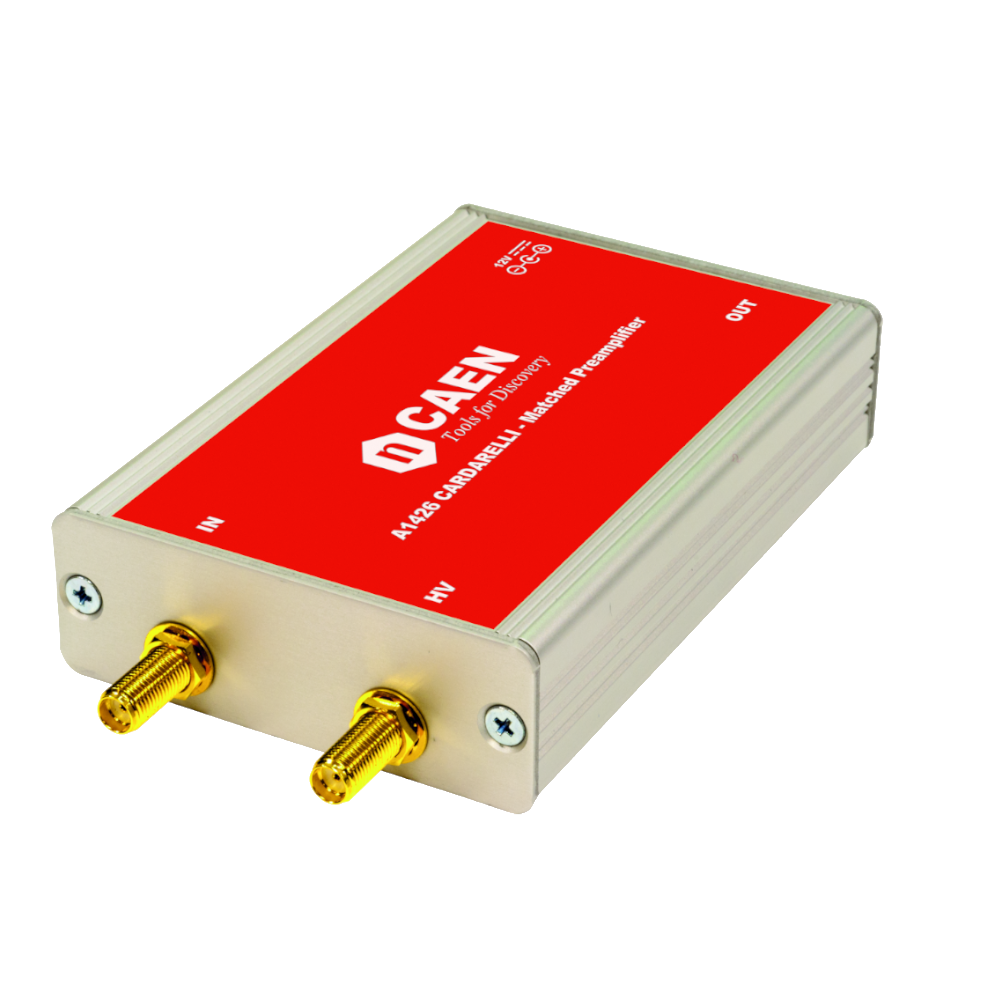
A1426 is a fast and low noise preamplifier with AC coupled input. It is composed by two amplification stages implementing BJT NPN silicon technology with optional A1430 wide band pulse polarity inverted. The amplifier A1426 has been designed to be used with fast detectors as e.g. diamond detectors, thin silicon detectors with 100 ps time resolution and high counting rate RPC.
The main feature of the A1426 amplifier is that the input impedance can be matched to a 50 Ohm transmission line, thus allowing to put the preamplifier far from the detector at a distance up to 100 m, without deteriorating its response in terms of equivalent noise. In particular, A1426 has an input impedance very close to 50 Ohm in the frequency range of interest. It Shows a discrete matching in the range 6 Mhz.
– 600 Mhz, and a RL > 13 dB in the range 6 Mhz – 320 Mhz.
Another important feature of A1426 is the fast shaping of the signal, down to 12 ns, that allows working at a rate of few MHz without incurring in signal pile-up.
A1426 is suited for detectors installed in hostile environments with high radiation flux and high temperature, when is not possible to connect the front-end electronics in proximity of the sensor (e.g. nuclear reactors or high intensity, high
ionizing particle beams). The amplifier, in fact, can be connected to the detector by means of a long cable without a significant degradation of its performance. Dedicated 50 Ω triaxial cables of different lengths are available on request.
Based on the fast preamplifier developed by R. Cardarelli, INFN Roma2
A1426 embeds an high voltage input and decoupling stage for detector bias rated up to 1 kV.
The module is powered by an external AC-DC stabilized power supply provided with the preamplifier.
Features
-
Fast, non-inverting preamplifier, positive output
-
Up to 5 mV/fC sensitivity
-
ENC of 0.3 fC (2000 e)
-
Input impedance can be matched to a 50 Ohm transmission line
-
Amplifier can be very far from the detector (up to 100m)
-
Output range 0 to 1 V
-
Output impedance of 50 Ohm
-
Up to 1 kV (positive or negative) detector bias voltage
A1426 CARDARELLI: Data Sheets

A1426 CARDARELLI: Download
Application Notes
Articles
Request a Quote

Footer