-
14-bit @ 250 MS/s
-
Analog inputs on MCX coaxial connectors
-
8 channels, Desktop module
-
0.5 and 2 Vpp selectable input dynamic range with programmable DC offset adjustment
-
Algorithms for Digital Pulse Processing
-
Pulse Height Analysis (DPP-PHA)
-
Pulse Shape Discrimination (DPP-PSD)
-
Zero Length Encoding (DPP-ZLEplus) – NEW
-
Dynamic Acquisition Window (DPP-DAW) – NEW
-
-
USB and Optical Link communication interfaces
-
Multi-board synchronization features
-
Daisy chain capability
-
Compliant with CoMPASS, MC2Analyzer, DPP-ZLEplus and DPP-DAW Demo Software, C and LabVIEW libraries

725S Digitizer family

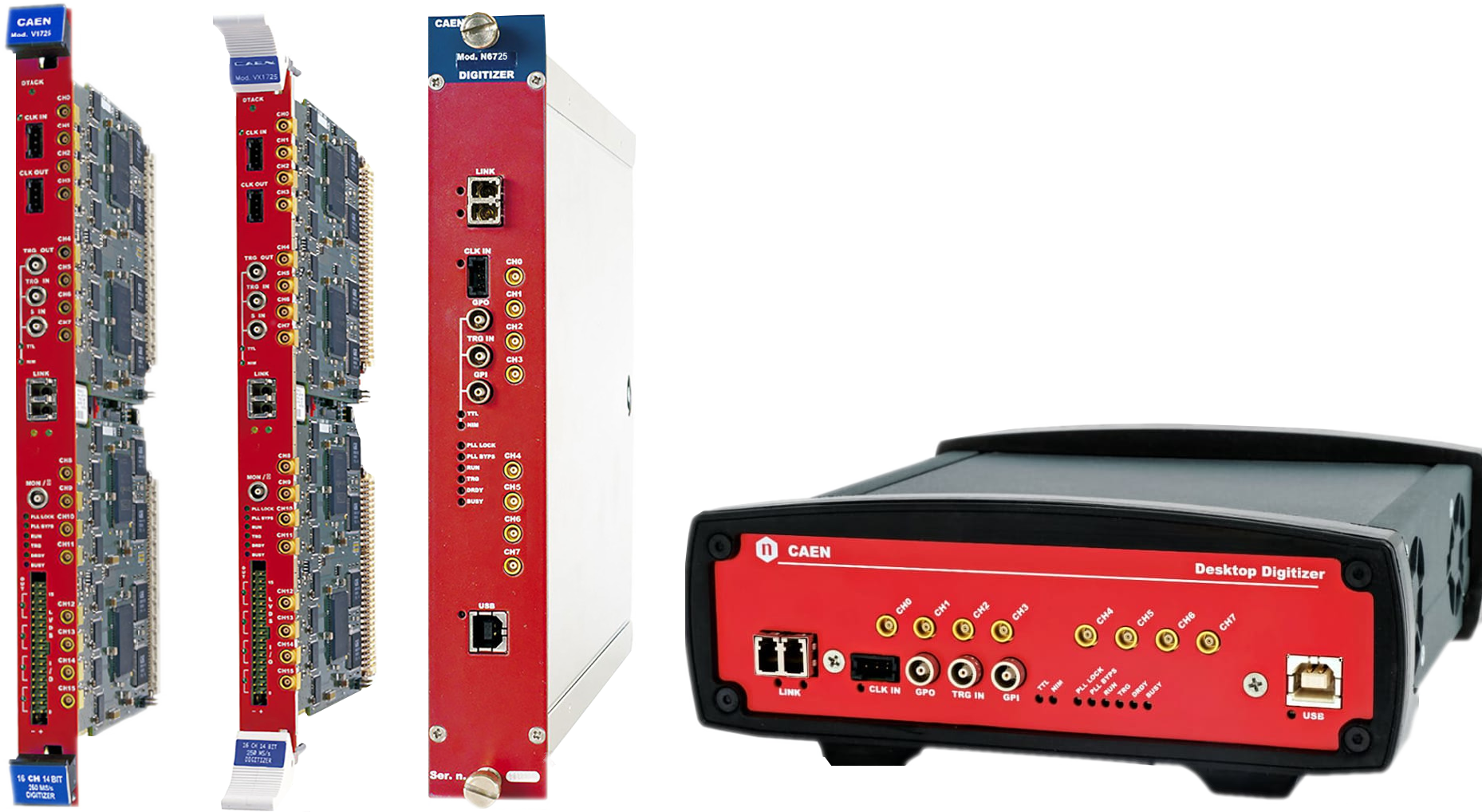


Digitizers 1.0
725S Digitizer family
The 725S family is a digitizer capable of recording waveforms along with performing advanced algorithms for online digital pulse processing (DPP). Utilizing DPP Firmware, users can acquire quantitative physical parameters (Integrated Charge, Pulse Shape Discrimination with very fine time resolution, Pulse Height Analysis) as well as read out waveforms with automatic pulse identification and baseline suppression on channel basis (Zero-Length Encoding and Dynamic Acquisition Window). The wide range of DPP algorithms supported by the 725S make it a “must-have” for any type of nuclear physics application.
The 725S (previously 725) has also been upgraded, introducing a larger FPGA to accommodate more complex DPP algorithms and a new A/D converter for better stability which does not require temperature-related calibration.
Input signals are read by a Flash ADC, 14-bit resolution and 250 MS/s sampling rate, which is well suited for mid-fast signals as the ones coming from liquid or inorganic scintillators coupled to PMTs or Silicon Photomultipliers, but also for high precision detectors as Silicon or HPGe coupled with charged sensitive preamplifiers. The acquisition can be channel independent and it is possible to make coincidence/ anti-coincidence logic among different channels and external veto/gating. Multiple boards can be synchronized to build up complex systems. In the case of DPP mode, data can be saved in time-stamped list mode to support higher input rates and improving the throughput performances. Piled-up events can be rejected or saved for oine analysis. The acquisition in DPP mode is fully controlled by the CoMPASS and MC2Analyzer software, which manage the algorithm parameters, build the plots and saves the relevant energy, time, and PSD spectra. In case of waveform recording mode, the user can take advantage of the CAENScope and WaveDump software to access and save the waveforms. Libraries and demo software in C and LabView are available for integration and customization of specific acquisition systems.
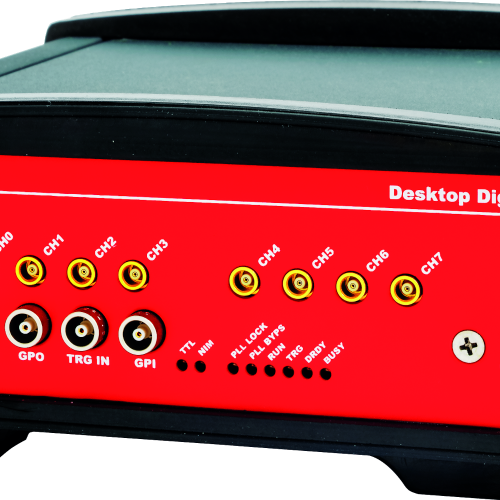
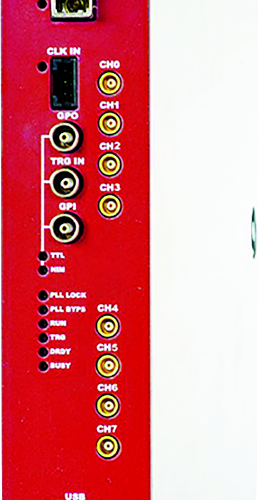
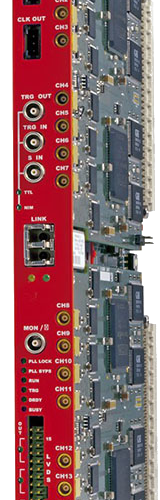
725S family comes in three form factors: VME64/VME64X (16 or 8 input channels), NIM (8 input channels) and Desktop (8 input channels). The communication to and from the board is provided through the following interfaces: USB (Desktop and NIM form factors), VMEbus (VME form factor), and Optical Link (all form factors).
Applications
-
Nuclear and Particle Physics
-
Dark Matter and Astroparticle Physics
-
Fast Neutron Spectroscopy
-
Fusion Plasma Diagnostic
-
Environmental Monitoring
-
Homeland Security
-
Resolution: 14-bit
-
Sampling Rate: 250 MS/s
-
Analog input on MCX coax. connectors
-
VME64/VME64X (16/8 ch.), NIM (8 ch.) and Desktop (8 ch.) modules
-
0.5 or 2 Vpp input dynamic range with programmable DC offset adj.
-
Algorithms for Digital Pulse Processing
-
VME64/VME64X, USB and Optical Link communication interfaces
-
Multi-board synchronization features
-
16 programmable LVDS I/Os
-
Daisy chain capability
-
Demo software tools, Control Software for waveform recording and DPP frmware, C and LabVIEW libraries
725S Digitizer family Models
DT5725 / DT5725S
N6725 / N6725S
-
8 channels, 14-bit @ 250 MS/s
-
Analog inputs on MCX coaxial connectors
-
0.5 and 2 Vpp selectable input dynamic range with programmable DC offset adjustment
-
Algorithms for Digital Pulse Processing
-
Pulse Height Analysis (DPP-PHA)
-
Pulse Shape Discrimination (DPP-PSD)
-
Zero Length Encoding (DPP-ZLEplus) – NEW
-
Dynamic Acquisition Window (DPP-DAW) – NEW
-
-
USB and Optical Link communication interfaces
-
Multi-board synchronization features
-
Daisy chain capability
-
Compliant with CoMPASS, MC2Analyzer, DPP-ZLEplus and DPP-DAW Demo Software, C and LabVIEW libraries
V1725 / V1725S
-
14-bit @ 250 MS/s
-
Analog inputs on MCX coaxial connectors
-
16/8 channels, 1-unit wide 6U VME64 module
-
0.5 and 2 Vpp selectable input dynamic range with programmable DC offset adjustment
-
Algorithms for Digital Pulse Processing
-
Pulse Height Analysis (DPP-PHA)
-
Pulse Shape Discrimination (DPP-PSD)
-
Zero Length Encoding (DPP-ZLEplus)
-
Dynamic Acquisition Window (DPP-DAW)
-
-
VME64 (VME64X compliant) and Optical Link communication interfaces
-
Multi-board synchronization features
-
16 programmable LVDS I/Os
-
Daisy chain capability
-
Compliant with CoMPASS, MC2Analyzer, DPP-ZLEplus and DPP-DAW Demo Software, C and LabVIEW libraries
VX1725 / VX1725S
-
14-bit @ 250 MS/s
-
Analog inputs on MCX coaxial connectors
-
16/8 channels, 1-unit wide 6U VME64 module
-
0.5 and 2 Vpp selectable input dynamic range with programmable DC offset adjustment
-
Algorithms for Digital Pulse Processing
-
Pulse Height Analysis (DPP-PHA)
-
Pulse Shape Discrimination (DPP-PSD)
-
Zero Length Encoding (DPP-ZLEplus) – NEW
-
Dynamic Acquisition Window (DPP-DAW) – NEW
-
-
VME64X and Optical Link communication interfaces
-
Multi-board synchronization features
-
16 programmable LVDS I/Os
-
Daisy chain capability
-
Compliant with CoMPASS, MC2Analyzer, DPP-ZLEplus and DPP-DAW Demo Software, C and LabVIEW libraries
Interfaces & I/O
USB An USB 2.0 link is provided in NIM and Desktop form factors for an easy data readout VME Digitizer can be controlled via USB using the CAEN V3718 VME-USB2.0 Bridge
Optical Link An Optical link is provided in any form factor for high performance data readout through CAEN proprietary daisy-chainable CONET communication protocol. it is possible to connect up to 8/32 ADC modules to a single Optical Link Controller (Mod. A4818/A3818)
Digital I/O Digital I/Os are provided in VME boards that can be used for individual trigger propagation to external trigger logic. This feature makes VME form factor ideal to scale up the acquisition channels where a global trigger generation is mandatory.
Footer