


XENON1T experiment observed the rarest decay process ever measured; this detector that was designed to probe dark matter, the ‘missing’ mass in the Universe, has seen an elusive nuclear decay called two-neutrino double electron capture — with implications for nuclear and particle physics.
Read the full article on nature.com
What is XENON1T Experiment
XENON experiment is a 3500kg liquid xenon detector to search for the elusive Dark Matter – construction of the next phase, XENON1T, started in Hall B of the Gran Sasso National Laboratory in 2014. The detector contains 3.5 tons of ultra radio-pure liquid Xenon, and has a fiducial volume of about 2 tons. The detector is housed in a 10 m water tank that serves as a muon veto. The TPC is 1 m in diameter and 1 m in height. The predicted sensitivity at 50 GeV/c2 is 2.0×10−47 cm2. This is 100x lower than the current limit published for XENON100.
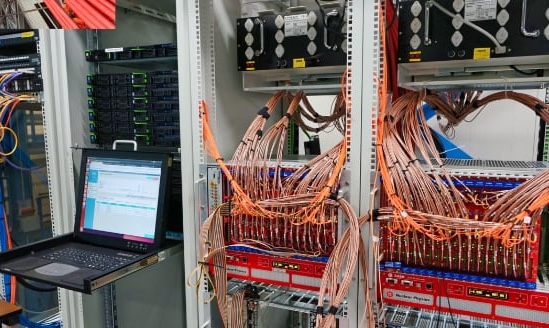
DAQ by CAEN
CAEN V1724 fADCs with 100 MHz sampling frequency and 40 MHz input bandwidth were used in XENON100 and used again in XENON1T but in this later stage the system has been upgraded to handle a larger amount of data. This lead to a rather short development time since old systems and software (also for data storage and data processing) can be largely re-used.
In XENON100 the maximum DAQ rate was increased by more than one order of magnitude compared to XENON10 – although the drift length was doubled and the number of channels increased by a factor 2.7 – by using an online data reduction technique. This FPGA based method is basically rejecting all baseline between peaks and reduces the amount of data to be transferred and stored dramatically.
Currently, the factor limiting the DAQ rate is the overall data throughput for the full DAQ line, starting from the VME bus to the transfer to the computer cluster above ground. This problem can be easily solved by parallelizing the DAQ system.

What is XENON1T Experiment
XENON experiment is a 3500kg liquid xenon detector to search for the elusive Dark Matter – construction of the next phase, XENON1T, started in Hall B of the Gran Sasso National Laboratory in 2014. The detector contains 3.5 tons of ultra radio-pure liquid Xenon, and has a fiducial volume of about 2 tons. The detector is housed in a 10 m water tank that serves as a muon veto. The TPC is 1 m in diameter and 1 m in height. The predicted sensitivity at 50 GeV/c2 is 2.0×10−47 cm2. This is 100x lower than the current limit published for XENON100.
DAQ by CAEN
CAEN V1724 fADCs with 100 MHz sampling frequency and 40 MHz input bandwidth were used in XENON100 and used again in XENON1T but in this later stage the system has been upgraded to handle a larger amount of data. This lead to a rather short development time since old systems and software (also for data storage and data processing) can be largely re-used.
In XENON100 the maximum DAQ rate was increased by more than one order of magnitude compared to XENON10 – although the drift length was doubled and the number of channels increased by a factor 2.7 – by using an online data reduction technique. This FPGA based method is basically rejecting all baseline between peaks and reduces the amount of data to be transferred and stored dramatically.
Currently, the factor limiting the DAQ rate is the overall data throughput for the full DAQ line, starting from the VME bus to the transfer to the computer cluster above ground. This problem can be easily solved by parallelizing the DAQ system.