

• Skip to main content
  • Skip to footer
CAEN logo light
  • About
    • Company Profile
    • Our policy
    • Sales network
    • Innovative Projects
    • Careers
    • How to reach us
  • Products
  • Resources
    • Documentation
    • FAQ
    • Glossary
    • Certifications
    • General Conditions
    • CAEN LHC Commitment
  • Support
  • Contact
Form FactorPower SupplyDigital SpectroscopyModular Pulse ProcessingEducationalFirmware & SoftwarePowered CratesAccessoriesWeeroc ProductsDigitizer FamiliessubfamilyWithoutFamilyFamiglia di provaProva Section1Categoria con name uguale a Section 2Sezione_di_testCategoria con label uguale a SectionCategoria con tutto ugualeTest section settembre

News

2016 IEEE NSS/MIC Event

Home Senza categoria Page 8

Senza categoria

2016 IEEE NSS/MIC Event

14/10/2016 by Nicole Filippi

CAEN is proud to announce its presence at 2016 IEEE Nuclear Science Symposium and Medical Imaging Conference.
We’ll be in booths #38 and #39 (Central Hall).

The NSS/MIC is a well-established meeting that has continuously provided an exceptional venue to showcase outstanding developments and contributions across the nuclear and medical instrumentation fields. This conference brings together engineers and scientists from around the world to share their knowledge and to gain insight and inspiration from others. The conference will include a distinguished series of short courses, relevant refresher courses, and workshops that will address areas of particular interest.

In this event, CAEN will examine in depth several applications about
Advanced pulse processing for Timing and Spectroscopy.
Don’t miss our showcase Thursday, November 3 at 2:00 pm October 29 – November 6, 2016 Strasbourg, France Web Site: http://2016.nss-mic.org/Schedule for the Technical Presentations
Filed Under: Senza categoria

730 Digitizers – Readout for Concealed Nuclear Materials Detection Application

05/02/2016 by Nicole Filippi

Researchers have demonstrated proof of concept for a novel low-energy nuclear reaction imaging technique designed to detect the presence of “special nuclear materials”-weapons-grade uranium and plutonium-in cargo containers arriving at U.S. ports. The method relies on a combination of neutrons and high-energy photons to detect shielded radioactive materials inside the containers.

The technique can simultaneously measure the suspected material’s density and atomic number using mono-energetic gamma ray imaging, while confirming the presence of special nuclear materials by observing their unique delayed neutron emission signature. The mono-energetic nature of the novel radiation source could result in a lower radiation dose as compared to conventionally employed methods. As a result, the technique could increase the detection performance while avoiding harm to electronics and other cargo that may be sensitive to radiation.

If the technique can be scaled up and proven under real inspection conditions, it could significantly improve the ability to prevent the smuggling of dangerous nuclear materials and their potential diversion to terrorist groups.

Supported the National Science Foundation and the U.S. Department of Homeland Security, the research was reported April 18, 2016 in the Nature journal Scientific Reports. Scientists from the Georgia Institute of Technology, the University of Michigan, and the Pennsylvania State University conducted this research, which is believed to be the first successful effort to identify and image uranium using this approach.

Readout for Concealed Nuclear Materials Detection Application article's preview image

“Once heavy shielding is placed around weapons-grade uranium or plutonium, detecting them passively using radiation detectors surrounding a 40-foot cargo container is very difficult,” said Anna Erickson, an assistant professor in Georgia Tech’s George W. Woodruff School of Mechanical Engineering. “One way to deal with this challenge is to induce the emission of an intense, penetrating radiation signal in the material, which requires an external source of radiation.”
The technique begins with an ion accelerator producing deuterons, heavy isotopes of hydrogen. The deuterons impinge on a target composed of boron, which produces both neutrons and high-energy photons. The resulting particles are focused into a fan shaped beam that could be used to scan the cargo container.
The transmission of high-energy photons can be used to image materials inside the cargo container, while both the photons and neutrons excite the special nuclear material-which then emits gamma rays and neutrons that can be detected outside the container. Transmission imaging detectors located in the line of sight of the interrogating fan beam of photons create the image of the cargo.
“The gamma rays of different energies interact with the material in very different ways, and how the signals are attenuated will be a very good indicator of what the atomic number of the hidden material is, and its potential density,” Erickson explained. “We can observe the characteristics of transmission of these particles to understand what we are looking at.”
When the neutrons interact with fissile materials, they initiate a fission reaction, generating both prompt and delayed neutrons that can be detected despite the shielding. The neutrons do not prompt a time-delayed reaction with non-fissionable materials such as lead, providing an indicator that materials of potential use for development of nuclear weapons are inside the shielding.
“If you have something benign, but heavy-like tungsten, for instance-versus something heavy and shielded like uranium, we can tell from the signatures of the neutrons,” Erickson said. “We can see the signature of special nuclear materials very clearly in the form of delayed neutrons. This happens only if there are special nuclear materials present.”
Earlier efforts at active detection of radioactive materials used X-rays to image the cargo containers, but that technique had difficulty with the heavy shielding and could harm the cargo if the radiation dose was high, Erickson said. Because it uses discrete energies of the photons and neutrons, the new technique minimizes the amount of energy entering the container.
Researchers at Georgia Tech-led by Erickson-and at University of Michigan and Penn State University-led by Igor Jovanovic, professor of nuclear engineering and radiological sciences – demonstrated that the technique works in a laboratory setting by detecting uranium plates and rods.
In testing conducted in collaboration with the Massachusetts Institute of Technology at the Bates Linear Accelerator Center, the researchers used a fan-like pattern of particles created by an ion accelerator and emitted at 4.4 and 15.1 MeV. The particles passed through a shielded radioactive material, and were measured on the other side with Cherenkov quartz detectors connected to photomultiplier tubes.
“This provided proof that the physics works, and that we can use these particles to actually distinguish among various materials, including special nuclear materials,” Jovanovic said. The technique has not yet been tested under the real-world conditions of a steel cargo container, but such demonstration may take place in the near future.
“The signals produced by photon and neutron detectors were digitized using 14-bit, 500-MHz, 8-channel desktop digitizers (CAEN DT5730). In delayed neutron measurements, a custom data acquisition suite was used, capable of digitizing 600-ns long waveforms at rates of up to 14 kHz. Full digital forms were stored and later used in the analysis..

In gamma ray transmission and imaging studies, the digitizer on-board field-programmable gate array (FPGA) was used to process and analyze the digitized waveforms in real time. The built-in firmware for pulse shape discrimination (PSD) and FPGAs were used to read out processed data in the form of energy per pulse. This method minimizes the data transfer rate between the digitizer and control software, which allows for the use of many detectors in parallel with few computational resources..”

Provided by: Georgia Institute of Technology

More information: Paul Rose, Anna Erickson, Michael Mayer, Jason Nattress and Igor Jovanovic, “Uncovering Special Nuclear Materials by Low-energy Nuclear Reaction Imaging,” (Scientific Reports, 2016). http://www.dx.doi.org/10.1038/srep24388

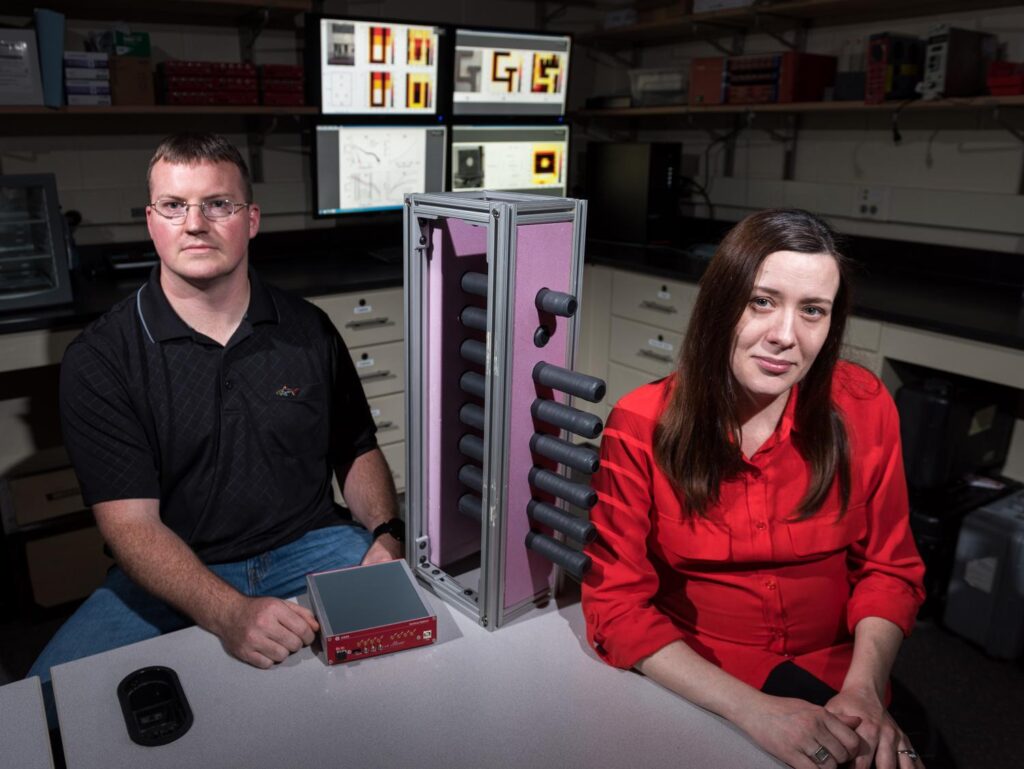
Photo description: Georgia Tech Graduate Student Paul Rose and Assistant Professor Anna Erickson are shown with desktop digitizer DT5730 and Cherenkov quartz detectors that would be used to image shielded radioactive materials inside cargo containers. (Credit: Rob Felt, Georgia Tech)

Filed Under: Senza categoria

CAEN awarded contract for PMTs Power Supply System of NA62 experiment at CERN

22/12/2011 by Nicole Filippi

CAEN awarded contract for the design and production of PMTs HV Power Supply System for NA62 LAV, MUV and CEDAR detectors

The NA62 is an experiment at CERN with the aim to measure the very rare kaon decay K+ -> pi+ nu nubar. Carried on at CERN SPS the experiment aims to collect about 80 K+ -> pi+ nu nubar events at the SM prediction with a signal to background ratio of 10:1 in two years of data taking.

For this purpose CERN awarded CAEN with a contract for the design and production of the High Voltage power supply system for photomultiplier tubes for the NA62 Large Angle photon Veto (LAV), Muon Veto detectors (MUV) and Differential Cherenkov counter (CEDAR).
CAEN will design and produce 115 multi-channel Power Supply modules (Mod. A1536) to power 2496 PMTs distributed in 12 stations along NA62 Experiment. Those boards will be hosted in 16 new SY4527 CAEN Mainframes.

A1536 Features

  • SY4527 form factor
  • 32 channel
  • Vout max: 3 kV
  • Vset/Vmon resolution: 200 mV
  • Vmon accuracy: 2 V
  • Iout max: 500 µA
  • Imon accuracy: 200 nA
  • Remotely controlled via OPC Server
  • Hardware Overcurrent Protection
  • Interlock via external signal

For more information about NA62 experiment please visit NA62 website.

Filed Under: Senza categoria

CAEN awarded contract for design and production of NA62 Liquid Krypton Calorimeter Readout Modules

10/10/2011 by Nicole Filippi

The NA62 is an experiment at CERN with the aim to measure the very rare kaon decay K+ -> pi+ nu nubar. Carried on at CERN SPS the experiment aims to collect about 80 K+-> pi+ nu nubar events at the SM prediction with a signal to background ratio of 10:1 in two years of data taking.

For this purpose CERN awarded CAEN Spa with a contract for the design and production of the Calorimeter REAdout Module (CREAM) for the NA62 high resolution Liquid Krypton Calorimeter (LKr) .

CAEN will design and build 455 CREAM modules for the readout of the 13249 LKr channels.

CREAM Features

  • VME64X compliant interface
  • VME 6U form factor
  • 32 channel
  • 14 bit 50 MS/s ADC
  • 2 Vpp input dynamics (differential)
  • 14-bit programmable DC offset adjustment (±1V)
  • Memory buffer:
    • 26 MB circular buffer
    • 5.2 GB event buffer
  • Gbit Ethernet port for data readout
  • VME64X compliant interface
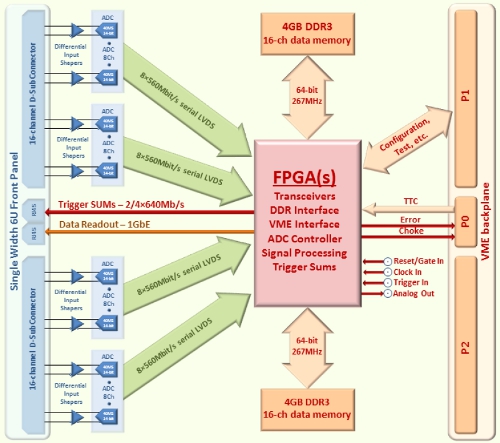
CREAM blk
CREAM block diagram

For more information about NA62 CREAM Module, please download the poster presented by V. Ryjov (CERN) at TWEPP 2011 (26-30 September 2011 Vienna, Austria).

For more information about NA62 experiment please visit NA62 website.

Filed Under: Senza categoria

  • « Go to Previous Page
  • Page 1
  • Interim pages omitted …
  • Page 6
  • Page 7
  • Page 8

Footer

CAEN S.p.A.

PI 00864500467 | REA: LU 102690

C.I.V.: 500.000€ | CDU A47Ø7H7

Caen Group Logo
Certificate ISO 9001:2015
Secured by Sectigo

About Us

  • Company Profile
  • Our policy
  • Sales network
  • Innovative Projects
  • Careers
  • How to reach us

Products

Applications

  • High Energy Physics
  • Astrophysics
  • Neutrino Physics
  • Dark Matter Investigation
  • Nuclear Physics
  • Material Science
  • Medical Applications
  • Homeland Security

Resources

  • Resources

Support

  • Getting Started with MyCAEN Portal

News

  • News

Contact Us

  • Contact

Login

    
  • Privacy Policy
  • Cookie Policy

Copyright © 2024 CAEN S.p.A. All rights reserved. Website by Addiction

✕