


Neutrino
Neutrinos are elusive subatomic particles that rarely interact with matter, making them extremely difficult to detect. Yet, they are fundamental to our understanding of particle physics and astrophysics, as they are produced in abundance by nuclear reactions in stars, supernovae, and other cosmic events. Scientists study neutrinos through vast underground and underwater detectors, observing the rare instances when neutrinos interact with atomic nuclei. These experiments, spread across the globe, provide insights into neutrino oscillations, masses, and the processes powering the universe, making neutrino research a crucial pursuit in the quest to unlock fundamental cosmic mysteries.

Examples of our products used:
CAEN products are widely used in neutrino physics, providing essential support for experiments that probe the fundamental properties of neutrinos and their interactions. From deep underground detectors to underwater observatories, CAEN’s high-precision power supplies and data acquisition systems deliver reliable performance in challenging environments, enabling accurate measurements of these elusive particles.

ICARUS Experiment
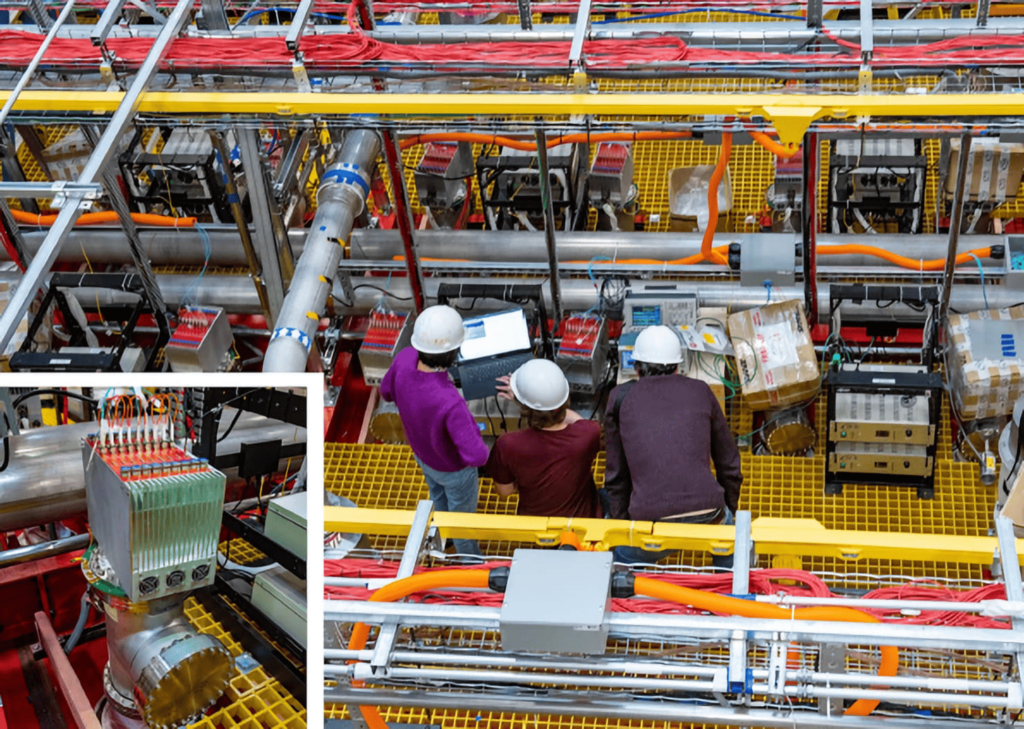
The ICARUS (Imaging Cosmic And Rare Underground Signals) experiment is a significant project in neutrino physics, designed to study neutrino interactions with high precision. Originally located at the Laboratori Nazionali del Gran Sasso (LNGS) in Italy, the ICARUS detector was later moved to CERN for refurbishment and then reassembled at Fermilab in the United States. In 2020, the detector was filled with 760 tons of liquid argon, marking it as the largest imaging Liquid Argon Time Projection Chamber (LAr TPC) ever built.
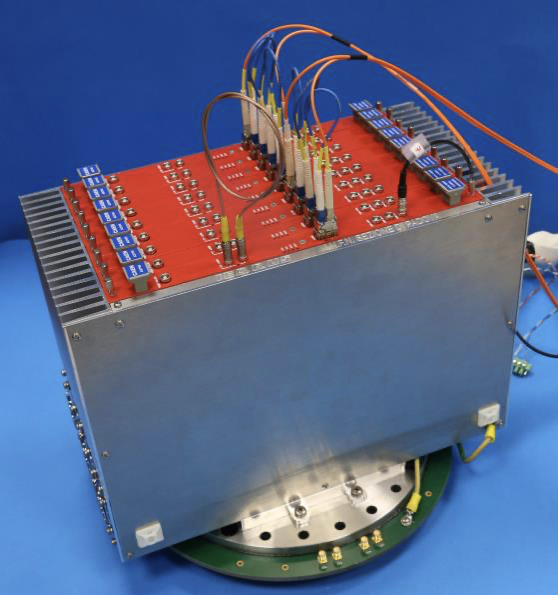
CAEN has developed specialized readout systems for the Liquid Argon TPC used in ICARUS, based on extensive experience from the original ICARUS T-600 experiment in collaboration with INFN Padova and ETH Zurich. The new CAEN A2795 readout module is integral to ICARUS’s data acquisition at Fermilab. Each A2795 board, optimized for liquid argon TPC applications, houses 64 channels and features plug-in hybrid circuits for preamplifiers, arranged in 8-channel arrays. This modular preamplifier design allows customization to match specific detector requirements, with the option to operate in a “Cold Option” configuration, where charge preamplifiers are positioned directly in the liquid argon to minimize noise and maintain signal fidelity.
Nine A2795 modules, providing a total of 576 channels, are mounted in a custom crate close to the detector. The A2795 boards digitize the analog signals from the preamplifiers using 12-bit, 2.5 MS/s ADCs, then process these signals via an internal FPGA, which performs data storage, trigger logic, and optical readout. The system interfaces with the host PC through CAEN’s A3818 PCI express board, using an optical link that allows remote operation up to several dozen meters, reducing noise from ground loops and enabling flexible placement.
Scalability is a core feature of this system. Each A3818 can control up to eight A2795 boards in a daisy chain, supporting configurations with thousands of channels by synchronizing multiple crates through the TT-Link. This single-wire bus distributes a unified clock and global commands, such as triggers, to maintain precise synchronization across the entire system. With this setup, ICARUS can capture high-resolution waveforms continuously, storing events in circular memory buffers with accurate timing tags.
JUNO Experiment – Jiangmen Underground Neutrino Observatory
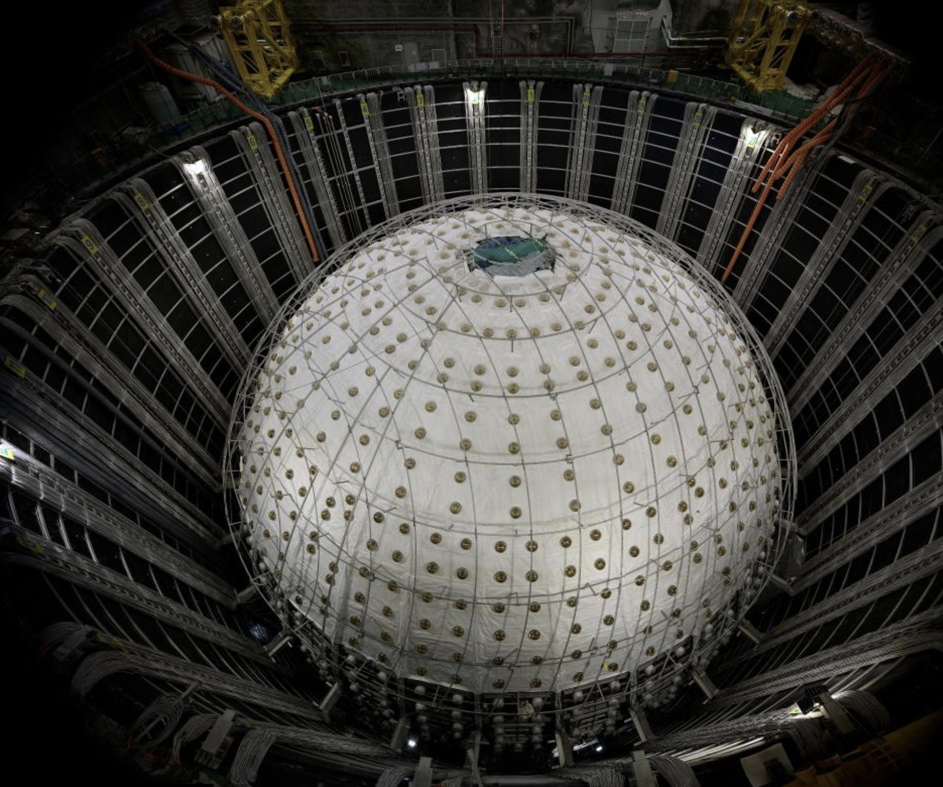
The Jiangmen Underground Neutrino Observatory (JUNO) is a major neutrino experiment located in southern China, with the primary goal of determining the neutrino mass hierarchy by studying reactor neutrinos. The central JUNO detector consists of a 20 kiloton liquid scintillator sphere surrounded by thousands of photomultiplier tubes (PMTs), achieving a high energy resolution crucial for precise measurements of neutrino oscillation parameters. In addition to reactor neutrinos, JUNO is designed to detect other neutrino sources, such as geo-neutrinos and supernova neutrinos.
The JUNO experiment integrates CAEN’s A1703 front-end board, which enables the collection and processing of signals from the detector. The A1703 is equipped with an ALTERA Cyclone V GX FPGA and is designed to handle the high rates of background radioactivity inherent to the JUNO site. This board facilitates efficient data acquisition, allowing precise timing and signal processing even under the elevated radioactivity conditions of the JUNO cavern.
Hyper-Kamiokande Experiment
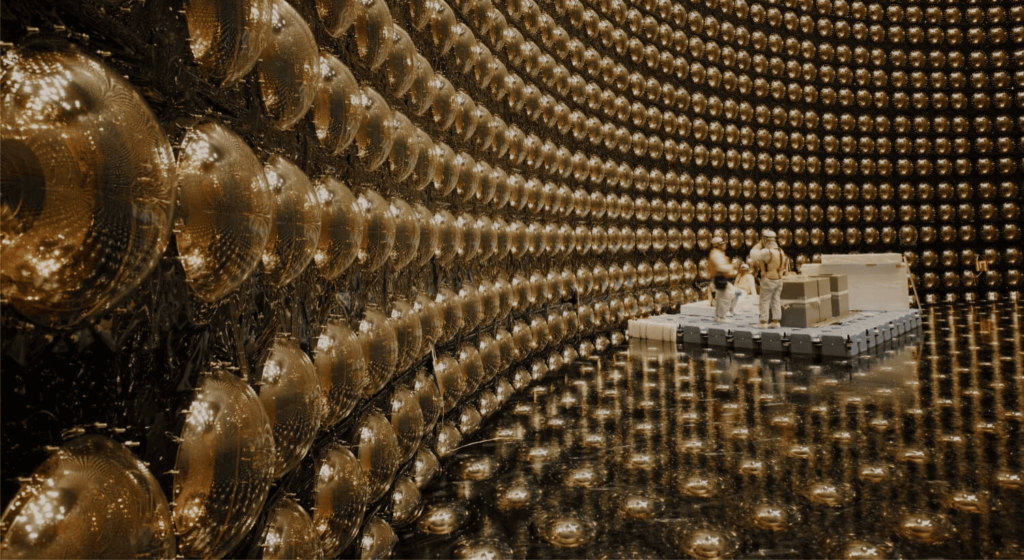
The Hyper-Kamiokande (Hyper-K) experiment in Japan is an advanced neutrino observatory designed to explore fundamental physics questions, including neutrino oscillations, proton decay, and astrophysical neutrino sources. Located deep underground to reduce interference from cosmic rays, Hyper-Kamiokande consists of a massive tank filled with ultrapure water. When neutrinos interact with the water molecules, they produce Cherenkov radiation, which is detected by an array of over 400 large photomultiplier tubes (PMTs) for precise measurement of neutrino events.
To meet the specific demands of this experimental setup, CAEN has provided a reliable underwater power supply system composed of 911 Low Voltage and High Voltage boards. The Low Voltage boards supply stable power to the High Voltage modules and digitizers, supporting both the power needs of the PMTs and data acquisition electronics. The High Voltage system, the A7026HK module (24 channels, 2.6 kV/500 μA each), is designed specifically to power the PMTs that capture Cherenkov light, ensuring a consistent and reliable signal.
Each component is engineered for high reliability with redundancy across both the high and low voltage systems. This redundancy ensures that even if a single component fails, the system remains operational, which is essential given the tank’s human-inaccessible environment. CAEN’s robust design also allows for extended maintenance intervals, a critical requirement for the remote and submerged setup of the Hyper-K detector, enhancing the stability and operational longevity of this groundbreaking experiment.