-
14 bit @ 1 GS/s ADC
-
16 single-ended analog inputs on MCX connectors
-
2Vpp input range with software selectable analog gain
-
Open FPGA programming through the graphical tool Sci-Compiler
-
Wide range of applications (from Nuclear and Particle Physics to High Timing Resolution, Fast Neutron Spectroscopy, Dark Matter and Astroparticle, Fusion Plasma diagnostic, and Homeland Security)
-
Suited for signals from fast organic, inorganic and liquid scintillators coupled to PMTs or SiPMs, Diamond detectors and others
-
On-board live selection between scope mode (common trigger) and DPP mode (independent channel self-trigger)
-
Wide selection of DPP algorithms (e.g. PSD, ZLE)
-
Rack mount brackets included
-
Multiboard Synchronization and system-building capabilities
-
Front panel fully programmable I/Os (4 LEMO TTL/NIM and 16 LVDS)
-
Special 125MS/s 14-bit DAC output (LEMO) for signal inspection or trigger sum
-
On-board Zynq® UltraScale+™ FPGA with embedded Linux-based ARM® processor
-
5GB of total acquisition memory (DDR4)
-
USB-3.0 type-C and 1/10 Gigabit Ethernet or optional CONET (CAEN daisy chainable Optical Link protocol) interfaces
-
Fully supported by CoMPASS and WaveDump2 readout software
-
SDK for embedded Linux processor and host PC


Digitizers 2.0 - Open FPGA
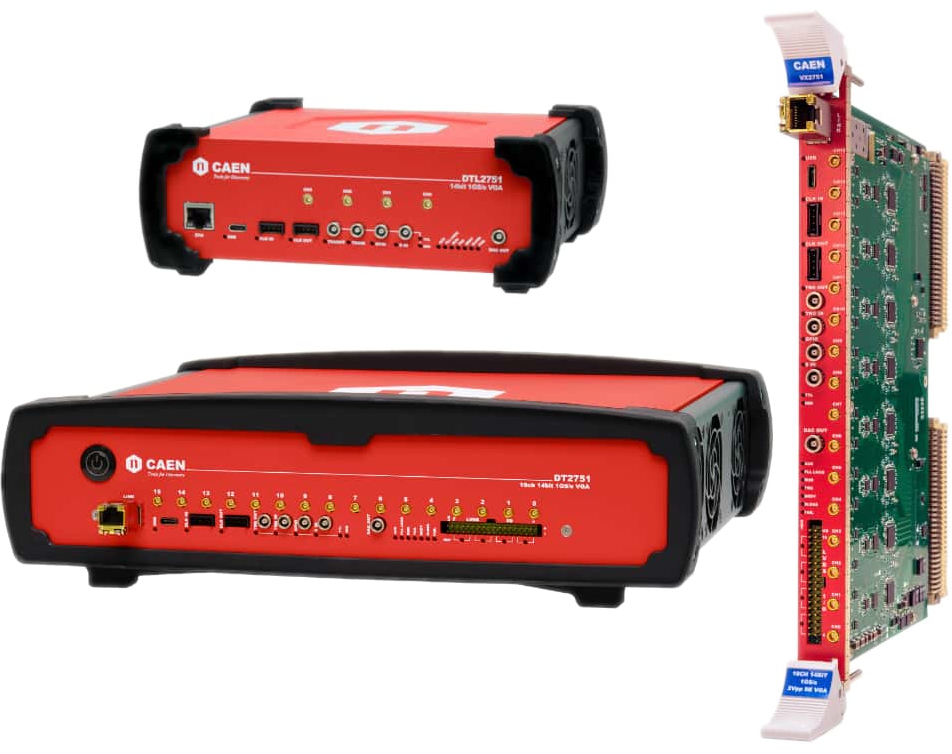
2751 Digitizer Family
The CAEN 2751 Digitizer Family is a high-performance solution designed for a wide range of radiation detection applications, including Nuclear and Particle Physics, High Timing Resolution measurements, Fast Neutron Spectroscopy, Dark Matter and Astroparticle research, Fusion Plasma diagnostics, and Homeland Security. Featuring 4 or 16 independent input channels with 14-bit ADCs operating at 1 GS/s, the digitizers are optimized to handle fast signals from organic, inorganic, and liquid scintillators coupled with PMTs or SiPMs, as well as Diamond detectors and other sensor types. Each input channel includes a software-selectable analog gain (VGA), allowing independent signal conditioning and optimization.
The 16-input channel models (DT2751 and VX2751) integrate a Xilinx Zynq UltraScale+ Multiprocessor System-on-Chip, enabling the execution of CAEN firmware, user-developed firmware via Open-FPGA blocks, and custom software routines running on the Open-Arm Linux platform.
The 4-input channel model (DTL2751) features a Xilinx Kintex UltraScale+ FPGA combined with an embedded ARM processor, offering a compact yet powerful solution for applications requiring fewer channels.
Available in Desktop (DT2751 and DTL2751) and VME64X (VX2751) form factors, the 2751 family provides a versatile platform suitable for both laboratory use and large-scale experimental setups.
The 2751 Digitizer Family can operate using both pre-configured firmware developed by CAEN and custom user-generated firmware, offering flexibility for a wide range of applications. Multiple firmware images can be stored simultaneously in the digitizer’s FLASH memory and quickly activated when needed. CAEN provides ready-to-use firmware solutions optimized for specific acquisition and processing needs:
-
Scope Firmware: Based on full waveform recording in triggered acquisition mode. A zero suppression function is available to reduce unnecessary data readout.
-
DPP-PSD Firmware: Implements Digital Pulse Processing algorithms for charge integration and pulse shape discrimination. Physical parameters such as energy, timestamp, and PSD are extracted from waveforms acquired in streaming readout mode. A CFD (Constant Fraction Discriminator) function is available for precise timestamping.
-
High-speed digitizer: 4 or 16 independent input channels, 1 GS/s 14-bit ADC, individual DC offset adjustment and Software selectable analog gain (VGA).
-
Available in Desktop (DT2751, DTL2751) and VME64X (VX2751) fully compliant with CAEN μ-crate module module
-
Front panel readout via USB-3.0 or 1/10Gb Ethernet
-
Embedded Processing (Open-ARM platform):
-
16 input channels (DT2751, VX2751): Xilinx Zynq® UltraScale+™ MPSoC with integrated Arm® CPU
-
4 input channels (DTL2751): Xilinx Kintex® UltraScale+™ FPGA with an embedded ARM processor
-
-
Open FPGA architecture fully supported by Sci-Compiler tool
-
Ready-to-Use Firmware solutions for Charge Integration (PSD) and Waveform Recording
-
Triggered and streaming readout modes supported
-
System features: Multi-board synchronization, digital I/Os for trigger logic, on-board storage of multiple firmware images, and integrated web interface
-
Software ecosystem:
GUI-based readout software available for multiparametric spectroscopy (CoMPASS) or waveform recording (WaveDump2)
Firmware/software generator and compiler for the Open FPGA (Sci-Compiler), eliminating the need for FPGA programming skills
Libraries (FELib) and demo codes are provided for software customization
x2751 Family – 14 bit 1 GS/s 16/4 Input Channels Models
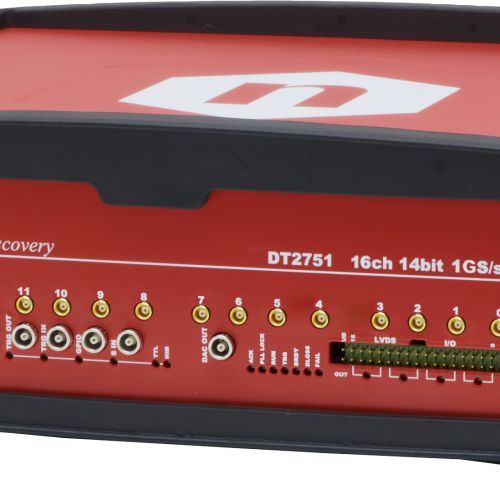
DT2751
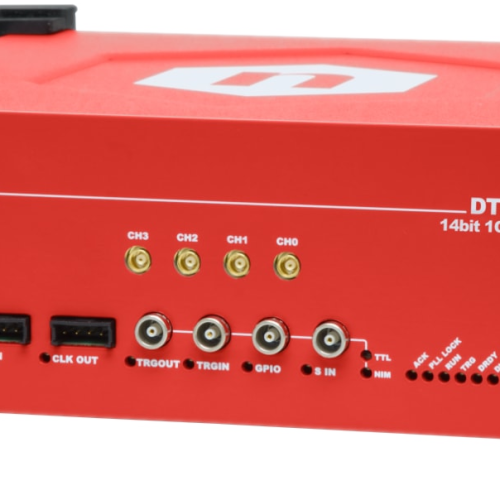
DTL2751
-
DTL2751 – 4 Ch. 14 bit 1 GS/s Digitizer
-
Based on Kintex UltraScale+ FPGA
-
USB-3.0 and 1 GbE fast communication interfaces
-
Triggered and streaming readout modes
-
Scope and DPP firmware solutions ready to use
-
FDK and SDK provided for Open FPGA and open Arm customizations
-
Sci-Compiler, WaveDump2, CoMPASS fully supported
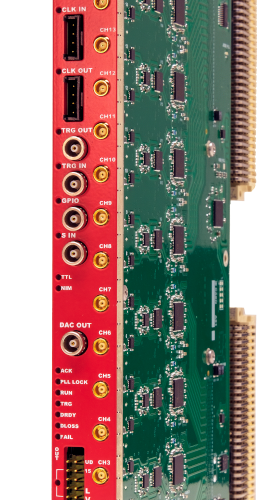
VX2751
-
14 bit @ 1 GS/s ADC
-
16 single-ended analog inputs on MCX connectors
-
2Vpp input range with software selectable analog gain
-
Open FPGA programming through the graphical tool Sci-Compiler
-
Wide range of applications (from Nuclear and Particle Physics to High Timing Resolution, Fast Neutron Spectroscopy, Dark Matter and Astroparticle, Fusion Plasma diagnostic, and Homeland Security)
-
Suited for signals from fast organic, inorganic and liquid scintillators coupled to PMTs or SiPMs, Diamond detectors and others
-
On-board live selection between scope mode (common trigger) and DPP mode (independent channel self-trigger)
-
Wide selection of DPP algorithms (e.g. PSD, ZLE)
-
Multiboard Synchronization and system-building capabilities
-
Front panel fully programmable I/Os (4 LEMO TTL/NIM and 16 LVDS)
-
Special 125MS/s 14-bit DAC output (LEMO) for signal inspection or trigger sum
-
On-board Zynq® UltraScale+™ FPGA with embedded Linux-based ARM® processor
-
5GB of total acquisition memory (DDR4)
-
USB-3.0 type-C and 1/10 Gigabit Ethernet or optional CONET (CAEN daisy chainable Optical Link protocol) interfaces
-
Fully supported by CoMPASS and WaveDump2 readout software
-
SDK for embedded Linux processor and host PC
Interfaces & I/O
USB
An USB-3.0 (tested up to 280 MB/s) type C link is provided in all form factors for an easy data readout.
Ethernet
The DT2751 and VX2751 models mount a SFP+ receptacle supporting 1 Gb Ethernet tested up to 110 MB/s or 10 Gb Ethernet (UDP) up to 850 MB/s on Copper RJ45 or optical LC transceiver. A RJ45 1GbE transceiver and a spare optical LC 10GbE one are provided with the board.
The DTL2751 model includes a standard 1 Gb Ethernet interface, suitable for reliable network connectivity and data acquisition.
Digital I/O
A set of sinlge-ended (NIM/TTL) digital I/Os on the front panel can be programmed for common and individual trigger propagation to external trigger logic, scaling up the acquisition input channels where a global trigger generation is mandatory. They can also be configured for sync, start and stop distribution in a multi-board system.

Data Acquisition
CAEN digitizers support multiple data acquisition modes, implemented as distinct FPGA firmware solutions, making them adaptable to a wide range of radiation detection applications in Nuclear Physics.
The CAEN 2751 Digitizer Family features 4/16 single-ended input channels, each capable of digitizing detector signals using a 14-bit ADC at 1 GS/s. Data acquisition is driven by trigger signal generation and the identification of a Region of Interest (ROI), defined in terms of sample count or time duration. Trigger sources can be local (channel self-trigger), external, or software-based. Once acquired, the digitized data is processed within the FPGA, stored in high-speed memory as events—including Trigger ID and Timestamp tags—and then transferred via high-bandwidth communication interfaces for further analysis. The digitizer supports different acquisition modes, designed to balance throughput, latency, and data efficiency according to experimental requirements:
-
Triggered Mode: All channels acquire data simultaneously upon a global trigger generated by a Central Logic Unit, which processes local triggers from individual channels. External and software triggers can also be configured as sources for the global trigger. Zero suppression algorithms can be applied to remove non-significant data and reduce the readout payload.
-
Streaming Readout Mode: Each channel autonomously identifies its ROI using the self-trigger mechanism, acquiring data independently of the other channels. This mode includes automatic zero suppression (non-triggered channels are not acquired), maximizes acquisition rates, and is ideal for applications requiring real-time parameter extraction. In addition, correlation logics can be configured to validate event acquisition upon coincidences or anticoincidences between local and external triggers.
CoMPASS multiparametric software
CAEN Multi-Parameter Spectroscopy Software (CoMPASS) is the DAQ software from CAEN able to implement a Multiparametric Data Acquisition for Physics Applications: the detectors can be connected directly to the digitizers/MCAs inputs and the software acquires energy, timing, and PSD spectra at the same time.
-
Simultaneous plot of waveforms, Time, Energy, PSD, and TOF spectra
-
Online filtering (Time, Energy, PSD)
-
Multi-board management
-
Advanced data saving
-
Root format data saving

WaveDump2 software
WaveDump2 software specifically supports the Scope firmware of the 27xx Digitizer families for waveform recording applications. Data acquisition from multiple boards and multi-board synchronized systems are managed through a dedicated toolbar.
-
Waveform recording application
-
Multi-board management
-
Simultaneous plot of waveforms from up to 8 input channels
-
Flexible and easy configuration of channel and trigger settings
-
Runtime FFT analysis

CAEN ToolBOX
CAEN Toolbox is a software utility designed to upgrade and manage the firmware on the 2751 Digitizer Family. Moreover, this highly versatile software suite supports a wide selection of CAEN devices, including front-end boards, Digitizer 1.0 and 2.0 series, bridges and controllers, PLU, and power supplies. It offers a user-friendly GUI or command line application to manage onboard firmware, perform debug tests, and execute other useful functions.

CAEN FELib Library
The CAEN x27xx waveform digitizers introduce a new approach to accessing firmware parameters by abstracting register-level controls into user-friendly library parameters. This simplifies the development of custom DAQ systems and software.
Control and data acquisition are managed through CAEN FELib, a cross-platform interface compatible with Windows® and Linux® (x86 and ARM). However, FELib itself does not support any specific digitizer family; users must also install the corresponding CAEN Digx library for their device.
-
Set of functions designed for controlling and utilizing Digitizers 2.0
-
Available in C/C++ and Python for both Windows and Linux operating systems.
-
Distributed as an open-source software under GNU LGPL v3 license

WEB Interface
There is a Web Interface integrated in the x2751 Digitizer that enables direct access to essential service functions via a standard web browser, without requiring external software. Key features include:
-
Real-time hardware status monitoring, with visibility on operating parameters and error notifications.
-
Network configuration, supporting both manual IP assignment and DHCP.
-
Firmware management, allowing upgrades and version selection directly from the interface.
-
Advanced configuration options, including PLL control for precise internal clock synchronization and manual setting of the library parameters.
-
Access via USB or Ethernet, with credential-based authentication supporting multiple user roles (administrator and standard user).

SCI-Compiler
The 2751 Digitizer Family can be programmed through the Sci-Compiler software for easy-FPGA programming. It is a block-diagram-based graphic tool, thought to help non-expert VHDL coders in building their own firmware. Each block defines an operational function (like a logic port, a trigger, a discriminator, a counter …) and more blocks can be wired together to build a complex FPGA code, so that it is possible to speed up the programming effort and get quickly to the testing and using phase. For a firmware project, Sci-Compiler can automatically generate C++/Python example software code to be used in Windows and Linux for DAQ software implementation.

Form Factor Interchange
The x2751 Digitizer introduces a form factor interchange additional feature, useful for efficiently commuting from laboratory experience to the experimental setup and vice versa.
The DT2751 Desktop digitizer can optionally be transformed in a 19″ rack mount board in few steps (rack mount kit included!).
The VX2751 VME digitizer may be turned into Desktop just plugging it into the single-slot VME64X μ-crate.

Footer