-
Gamma Spectroscopy: from system linearity to radiation absorption, Photonuclear and Compton Scattering cross sections
-
Beta Spectroscopy: from energy spectrum to thickness measurements
-
Cosmic rays: from cosmic rays detection to cosmic vertical flux measurement
-
Photon detection: light distribution and single photon detection
-
Radiation-Matter Interaction: from scintillating materials to absorber materials comparison
-
Advanced Statistics
-
A complete LabVIEW based software suite for remote control of the system and for data analysis

Cosmic rays are energetic, subatomic particles constantly bombard the Earth’s atmosphere from all directions

Nuclear and Particle Physics Experiments
Cosmic Rays
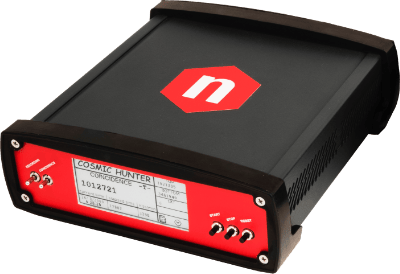
- SG6211 – Muons DetectionCosmic rays detection by using a system composed of a plastic scintillating tile directly coupled to a Silicon Photomultiplier detector.
- SG6212 – Muons Vertical Flux on Horizontal DetectorMeasurement of the muon vertical flux on a plastic scintillating tile. Estimation of the detection efficiency of the system by comparison between the expected rate and the measured one.
Equipment
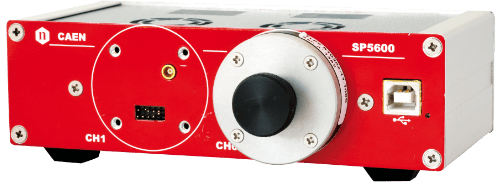
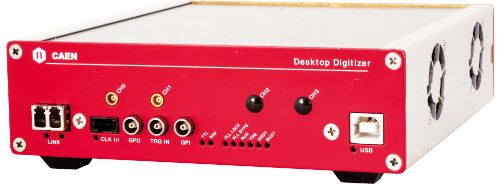
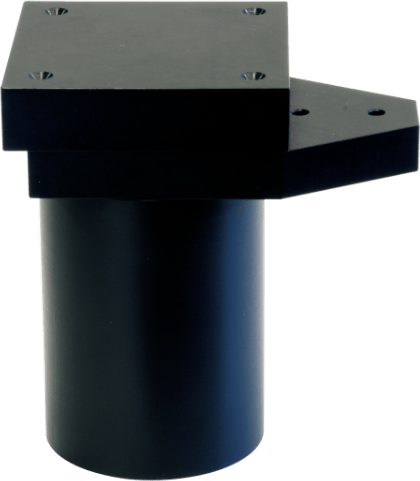
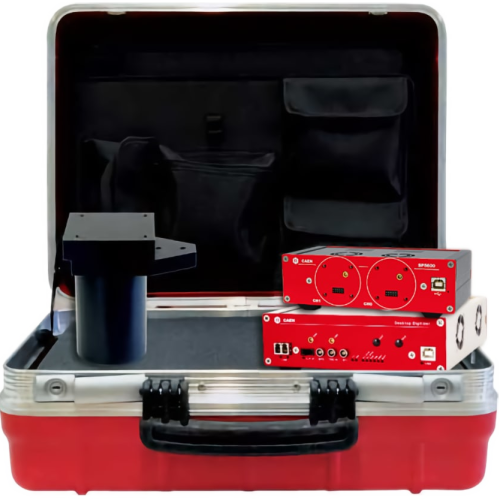
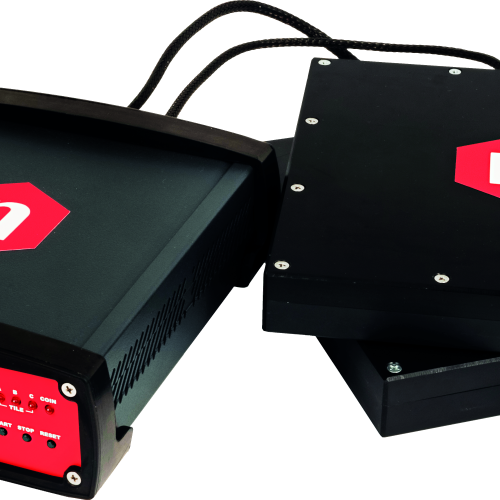
| SP5600 | DT5720A | SP5608 |
|
Power Supply & Amplification Unit
|
Desktop Digitizer 250 MS/s
|
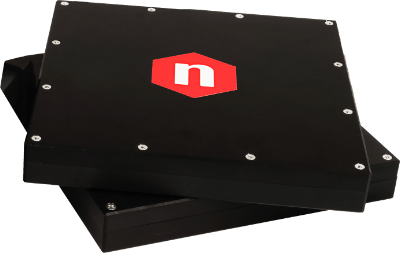
Scintillating tile
|
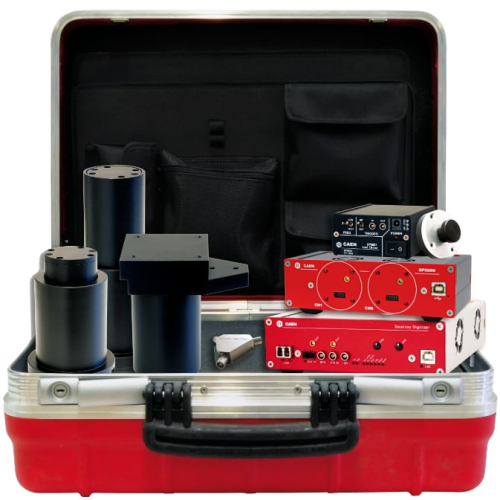
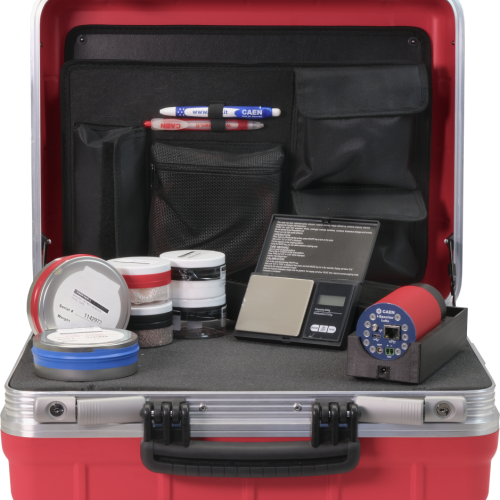
SP5600AN – Educational Kit – Premium Version
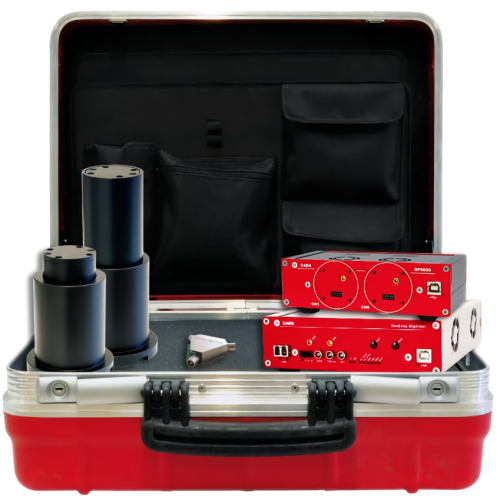
| SP5600 | DT5720A | A315 | SP5606 | SP5607 | SP5601 | SP5650C | SP5608 |
|
Power Supply & Amplification Unit
|
Desktop Digitizer 250 MS/s
|
Splitter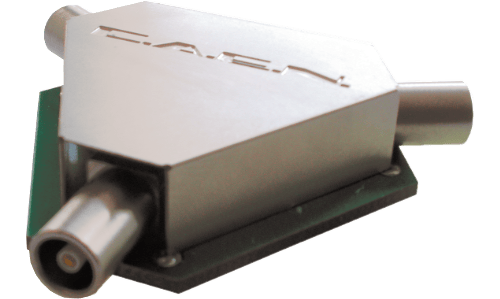 |
Mini Spectrometer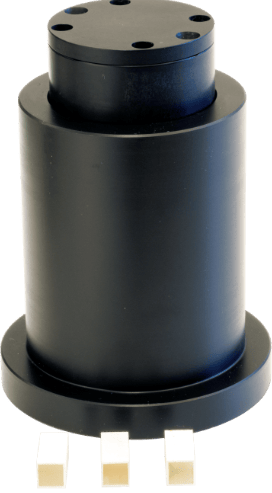 |
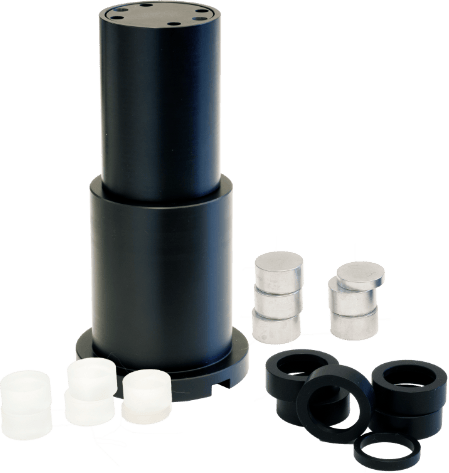
Absorption Tool
|
LED Driver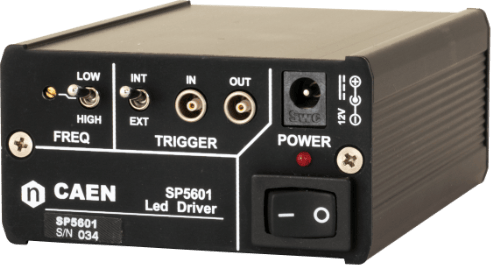 |
Sensor Holder for SP5600 with SiMP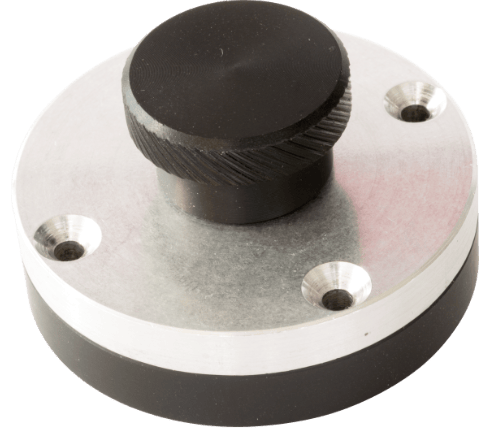 |
Scintillating tile
|
| Detection – Coincidence Unit | Scintillating tiles |
|
|
|
The cosmic radiation, discovered by Victor Hess1 in 1912, includes all stable charged particles and it is composed by two component: “primary” and “secondary” cosmic rays. Essentially, the first ones are composed by heavy nucleus, protons (~90%) and helium (~10%), but also electrons, neutrinos, photons, some light nucleus and antimatter (positron and antiprotons). These particles are accelerated by astrophysical sources and by interacting with the terrestrial atmosphere, they mainly produce the “secondary” cosmic rays: pions, kaons and electromagnetic showers. Muons and neutrinos are products of the decay chain of charged mesons, while electrons and photons originate in decays of neutral mesons.
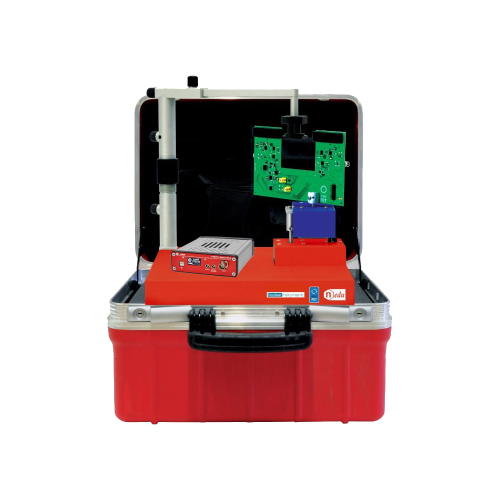
The experiments on cosmic rays proposed in this section are performed by using the “Educational Beta KIT”. The first application is qualitative and it is based on the verification of the cosmics. The second experiment allows the measure the cosmic flux on horizontal scintillating tile. Coming soon a Cosmic telescope will be available in order to perform the third step and measure the flux azimuthal variation.
The experiments on cosmic rays proposed in this section are performed by using the “Educational Beta KIT”. The first application is qualitative and it is based on the verification of the cosmics. The second experiment allows the measure the cosmic flux on horizontal scintillating tile. Coming soon a Cosmic telescope will be available in order to perform the third step and measure the flux azimuthal variation.
(1) Nobel Prize in Physics in 1936.
Cosmic rays are energetic, subatomic particles constantly bombard the Earth’s atmosphere from all directions Models
SP5600AN
SP5600C
-
Poisson and Gaussian Distribution
-
Gamma spectrum
-
System linearity
-
Energy resolution
-
Radiation-Matter Interaction: relative light yield of the different scintillators
-
Volume and Energy effects in the peak-to-total ratio
-
Absorption measurements
-
A complete LabVIEW based software suite for remote control of the system and for data analysis
SP5600D
-
Cosmic Rays: from cosmic rays detection to cosmic vertical flux measurement
-
Beta spectroscopy: from energy spectrum to thickness measurements
-
Radiation-Matter Interaction and Absorption coefficient measurements
-
A complete LabVIEW based software suite for remote control of the system and for data analysis
SP5600E
-
Photon detection: light distribution and single photon detection
-
Advanced Statistics
-
State-of-art sensor to explore the quantum world
-
A complete LabVIEW based software suite for remote control of the system and for data analysis
SP5600EMU
-
Gamma and Alpha Spectroscopy and System Linearity
-
Real Energy spectrum emulation
-
Noise emulation
-
Time distribution Emulation (Poissonian)
-
Continuous pre-amplifier emulation
-
Statistic
-
No need of radioactive source
-
User Friendly Control SW with Graphical User Interface
SP5620CH
-
Based on SiPM detectors and plastic scintillating tiles
-
Up to 3 scintillating tiles management
-
Flexible system geometry
-
No Needs SW interface
-
Embedded E Ink Display
-
SD card to download data
SP5630EN
-
Embedded web interface with spectrum analysis tools
-
Based on Silicon Photomultipliers (SiPM) matrix coupled to a CsI Scintillator
-
Well suited for:
-
Energy Calibration
-
Environmental background measurements
-
Passive Radon measurements
-
Samples and Photopeaks identification
-
Environmental Sample measurements
-
SP5701
-
Gamma Spectroscopy and System Linearity
-
Positron Annihilation Detection
-
Nuclear Imaging
-
Two-dimensional Reconstruction of a Radioactive Source
-
Source Spatial Resolution
-
Efficiency measurements
-
User Friendly Control SW with Graphical User Interface
Footer