-
1 channel
-
Pulser/Emulator operating modes
-
Real Energy spectrum emulation
-
Time distribution emulation (Poisson)
-
Noise emulation
-
Continuous pre-amplifier emulation
-
Nuclides database
-
USB interface
-
User Friendly Control SW with Graphical User Interface

Digital Detector Emulators

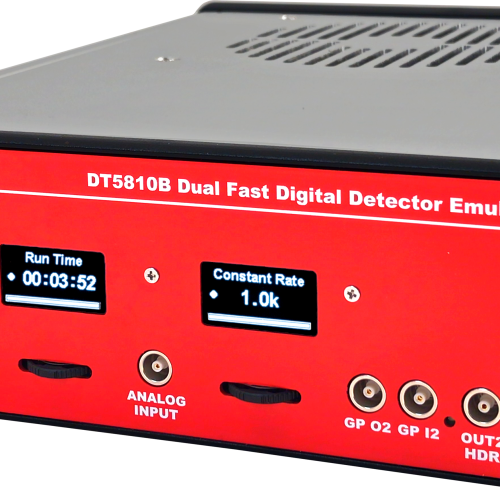
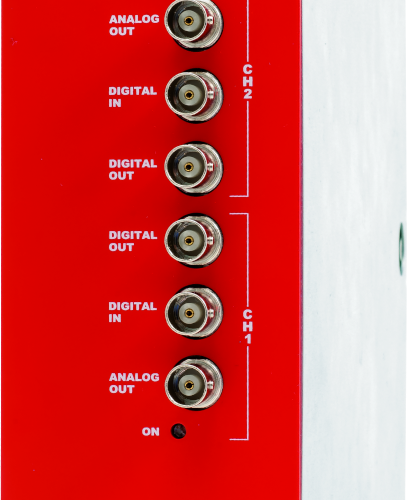
Digital
Digital Detector Emulators
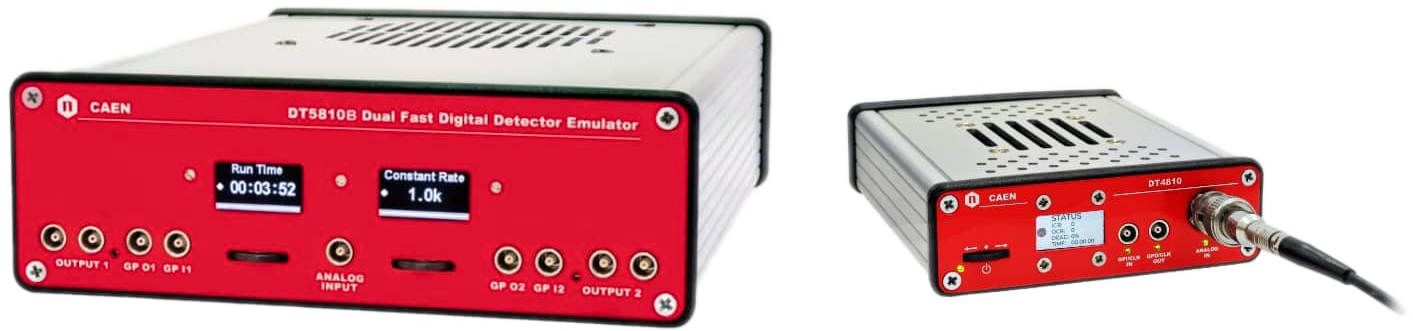
The Digital Detector Emulators are multichannel instruments for the emulation of radiation detection systems.These devices represent an hardware application of the well-known Monte Carlo simulation method, synthesizing a continuous stream of pulses according to an user programmable set of statistical distributions such as energy spectra, time distribution, noise, etc.In addition, energy spectra and template waveforms acquired by other instrumentation (MCAs, digital oscilloscopes, etc.) can be loaded as a source of the emulation. The detector emulator can reproduce signals from a real energy spectrum that can be uploaded in the form of CSV or ANSI N42.42 files.A database of nuclides is provided to generate specific emission lines and Gaussian noise can be added. An user friendly control software is provided with the unit.
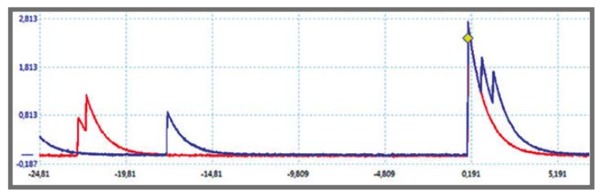 Signal pile-up is another experimental condition that can be fully emulated and controlled by the user.When the emulation process is reset, the sequence can be either re-initialized with new random data or reproduced the same many times, in order to study, for example, the effect of acquisition changes on the same data set.Each channel can be independently programmed with its own statistics.The Digital Detector Emulators are controlled by a dedicated Control Software with advanced graphical user interface for a full control of all the emulation parameters.
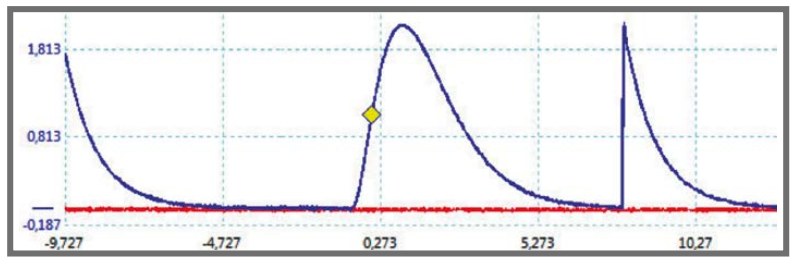 These features, together with the possibility to work as waveform/function generators, make the Digital Detector Emulators the perfect tools for testing and developing DAQ solutions, bringing an experimental setup on your desktop.
The user can either run different channels by uncorrelating or correlating them in different ways:
- Channel 1 sequence can be a copy of Channel 0 one shifted in time.
- A sub set of events from Channel 1 can share the same Energy Spectrum of Channel 0.
- The two channel scan work in a Master/Slave configuration, in which Channel 0 works as a trigger for Channel 1 that conserves its own statistics.
Another interesting feature (DT4800 excluded) is the possibility to generate different pulse shapes on the same channel with a predefined “mixture” percentage of the two, in order to emulate for example neutron pulses in a gamma ray background.The capability to add different noise and interference figures improves the emulation process, giving the possibility to operate out of ideal but not realistic conditions.CAEN Digital Detector Emulators are available in 5 models:
- Features from a set of user defined customized setting
- Energy Distribution and Time Distribution
- Signal Shape
- Pile-up Emulation
- Baseline Drift
- Noise & Interference
- Multiple Shapes Emulation
- Correlated Events Generation
- Real Analog Input
- Continuous and Pulsed reset Preamplifier
- Features of emulated analog outputs for several kind of applications:
- Remote Experimentation
- DAQ electronics Test and Development
- Educational Applications
- Test of user defined algorithms:
- Pulse Shape Discrimination
- Events Correlation
- Timing Resolution
Digital Detector Emulators Models
Discontinued
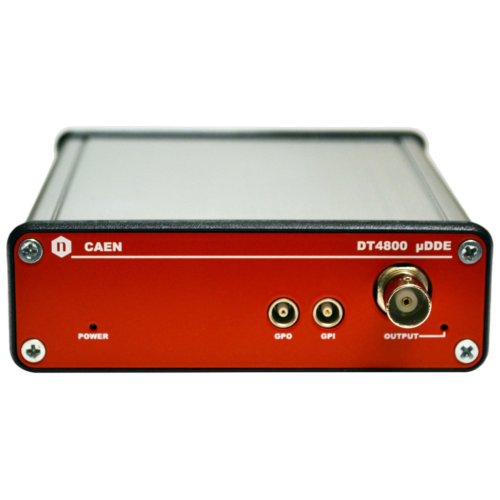
DT4800
New
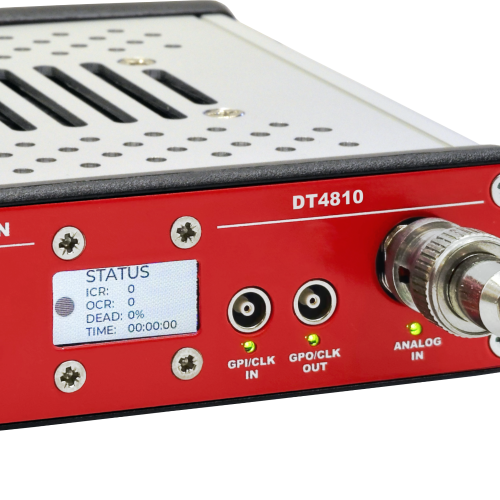
DT4810
-
Emulation of detector-like signals
-
500 MSps 14-bit DAC
-
Analog output rise time down to 5 ns and exponential signal decay time up to 200 µs
-
Nuclides database with more than 50 real acquired spectra
-
White noise, random walk and continuous reset preamplifier emulation
-
USB 2.0, 1 Gbit Ethernet
-
Web-based GUI
-
Standalone basic operation through the front panel display
-
Improved output signal quality
-
SiPM detector emulation
-
User-friendly web interface for control and visualization
-
JupyterLab support for Python scripting (Coming Soon)
DT5800
-
2 Channels
-
Pulser/Emulator/Function Generator operating modes
-
Energy spectrum emulation
-
Time distribution emulation
-
Custom signal shape emulation
-
Pile-up emulation
-
Noise and periodic interference emulation
-
Baseline drift
-
12 ps/step programmable delay generator
-
Correlated signals generation on the two output channels
-
Multiple shape on the same channel for testing of pulse shape discrimination
-
Continuous and pulsed reset pre-amplifier emulation
-
Nuclide Database
-
USB interface
-
Windows Software
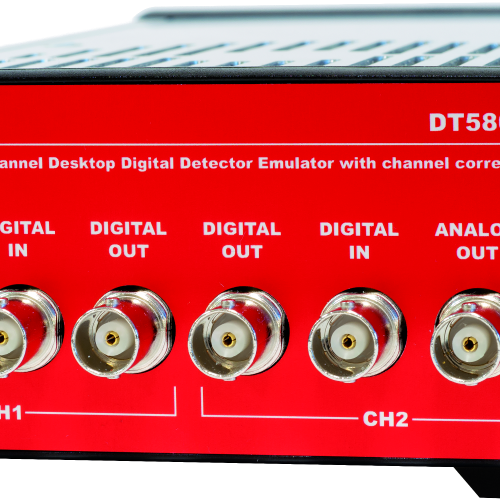
DT5810
-
2 channels
-
1 ns Rise Time
-
Pulser/Emulator/Function Generator operating modes
-
Energy spectrum emulation
-
Time distribution emulation
-
Custom signal shape emulation
-
Pile-up emulation
-
Noise emulation
-
Baseline drift
-
1 ns/step programmable delay generator
-
Correlated signals generation on the two output channels
-
Multiple shapes on the same channel for testing the pulse shape discrimination
-
Continuous and pulsed reset pre-amplifier emulation
-
Nuclide Database
-
Analog input for recording signals from real detectors
-
USB interface
-
Windows software for full system management
NDT6800
-
2 channels
-
2 units, NIM standard
-
Either backplane or AC-DC power supply
-
Pulser/Emulator/Function Generator operating modes
-
Energy spectrum emulation
-
Time distribution emulation
-
Custom signal shape emulation
-
Pile-up emulation
-
Noise and periodic interference emulation
-
Baseline drift
-
12 ps/step programmable delay generator
-
Correlated signals generation on the two output channels
-
Multiple shape on the same channel for testing of pulse shape discrimination
-
Continuous and pulsed reset pre-amplifier emulation
-
Nuclide Database
-
USB 2.0 interface
-
Windows Software
Footer