
Dark Matter
Dark Matter is a mysterious form of matter that does not emit or interact with electromagnetic radiation, making it invisible to direct observation. Despite this, it is believed to constitute about 85% of the universe’s mass, playing a key role in the formation and behavior of galaxies. Scientists detect dark matter indirectly by studying its gravitational effects on visible matter, using methods like gravitational lensing and particle detectors.
Though elusive, dark matter remains central to understanding the universe’s structure and evolution, driving ongoing research in astrophysics.
Dark Matter Observation with Large Detectors
Large-scale experiments are crucial in the search for dark matter, relying on indirect detection methods. The XMASS experiment at Kamioka, Japan, uses liquid xenon to detect rare particle interactions, while Italy’s XENON1T at the Gran Sasso Laboratory (LNGS) is one of the most sensitive dark matter detectors globally.
In Canada, the DEAP-3600 experiment at SNOLAB employs liquid argon to capture possible dark matter signals. Additionally, the SABRE South experiment in Australia is advancing global efforts by refining detection techniques. These collaborative projects represent significant steps toward understanding dark matter.

Examples of our products used:
CAEN products are widely used in various high-energy physics experiments and dark matter detection projects where precision in data collection and signal processing is essential for detecting rare particle interactions. These instruments play an important role in enabling accurate measurements and ensuring the reliability of complex experimental setups.
XMASS Experiment – Data Acquisition System
The XMASS detector is located underground (2,700 m water equivalent) in the Kamioka Observatory in Japan. It is a single phase liquid xenon scintillator detector containing 835 kg of liquid xenon in an active region. The volume is viewed by 630 hexagonal and 12 cylindrical Hamamatsu R10789 photomultiplier tubes (PMTs) arranged on an 80 cm diameter pentakis-dodecahedron support structure.
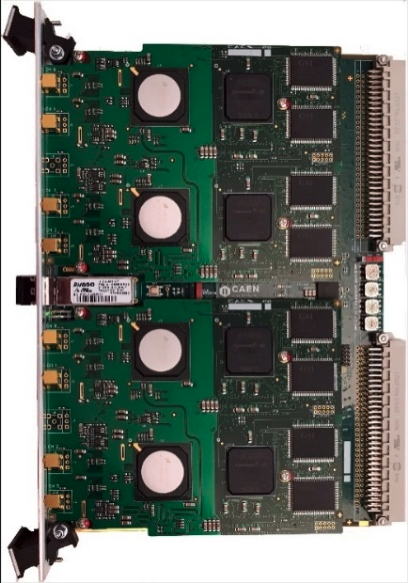
The acquisition electronics includes 87 V1751 CAEN Digitizers equipped with a customized Firmware. An on-board FPGA allows to operate the ADCs in a mode where only parts of the waveform around a peak are recorded, discarding data in a band around the baseline (zero-length-encoding).
XENON1T Experiment – Data Acquisition System
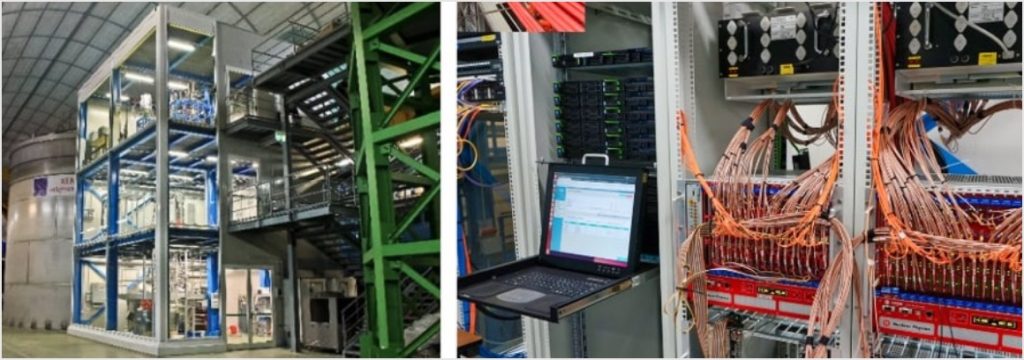
XENON experiment is a 3500kg liquid xenon detector to search for the elusive Dark Matter – construction of the next phase, XENON1T, started in Hall B of the Gran Sasso National Laboratory in 2014. The detector contains 3.5 tons of ultra radio-pure liquid Xenon, and has a fiducial volume of about 2 tons. The detector is housed in a 10 m water tank that serves as a muon veto. The TPC is 1 m in diameter and 1 m in height. The predicted sensitivity at 50 GeV/c2 is 2.0×10−47 cm2. This is 100x lower than the current limit published for XENON100.
The acquisition electronics includes 32 V1724 CAEN fADCs with 100 MHz sampling frequency and 40 MHz input bandwidth were used in XENON100 and used again in XENON1T but in this later stage the system has been upgraded to handle a larger amount of data. This lead to a rather short development time since old systems and software (also for data storage and data processing) can be largely re-used.
In XENON100 the maximum DAQ rate was increased by more than one order of magnitude compared to XENON10 – although the drift length was doubled and the number of channels increased by a factor 2.7 – by using an online data reduction technique. This FPGA based method is basically rejecting all baseline between peaks and reduces the amount of data to be transferred and stored dramatically.
Currently, the factor limiting the DAQ rate is the overall data throughput for the full DAQ line, starting from the VME bus to the transfer to the computer cluster above ground. This problem can be easily solved by parallelizing the DAQ system.
DEAP-3600 Experiment – Data Acquisition System
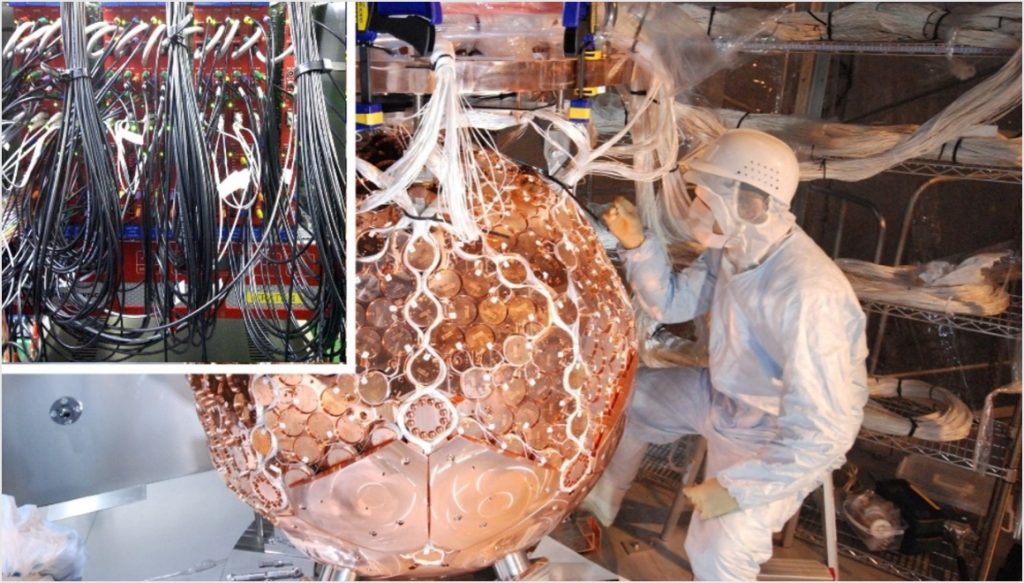
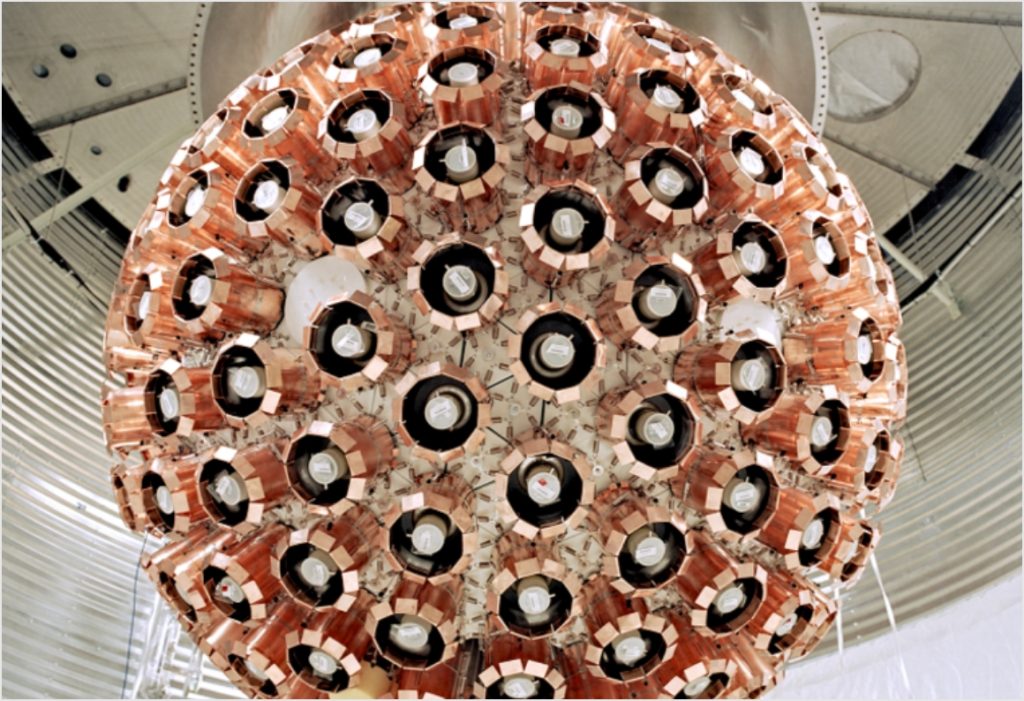
The DEAP-3600 detector is located 2 km underground at SNOLAB in Canada, shielded by 6,000 meters of water equivalent to reduce background radiation. It uses a single-phase liquid argon target containing 3,600 kg of liquid argon in the active region to search for dark matter. The argon is viewed by 255 photomultiplier tubes (PMTs) mounted on a spherical acrylic vessel, which is surrounded by a water tank for further shielding. The detector is designed to observe scintillation light produced when potential dark matter particles interact with argon nuclei.
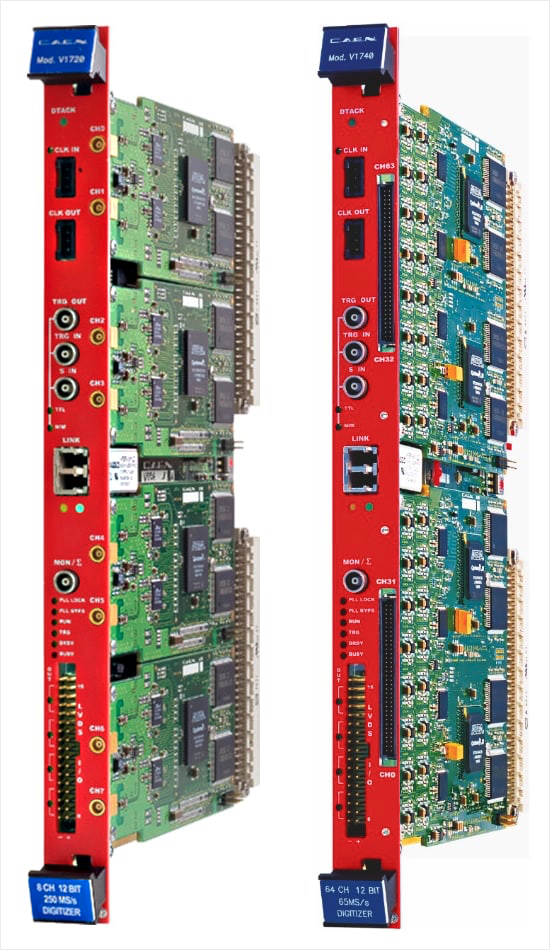
The acquisition electronics includes 32 V1720 CAEN digitizers (250 MS/s, 12-bit) and 5 V1740 CAEN digitizers (62.5 MS/s, 12-bit). These digitizers handle the readout from the photomultiplier tubes (PMTs) in the detector. The V1720 modules are optimized for higher resolution sampling, while the V1740 units are designed for lower-frequency signals but still provide critical input for pulse-shape discrimination and event characterization. These digitizers help capture the scintillation signals produced by particle interactions in the liquid argon, ensuring precise detection and data processing essential for dark matter searches.
SABRE South Experiment – Data Acquisition System
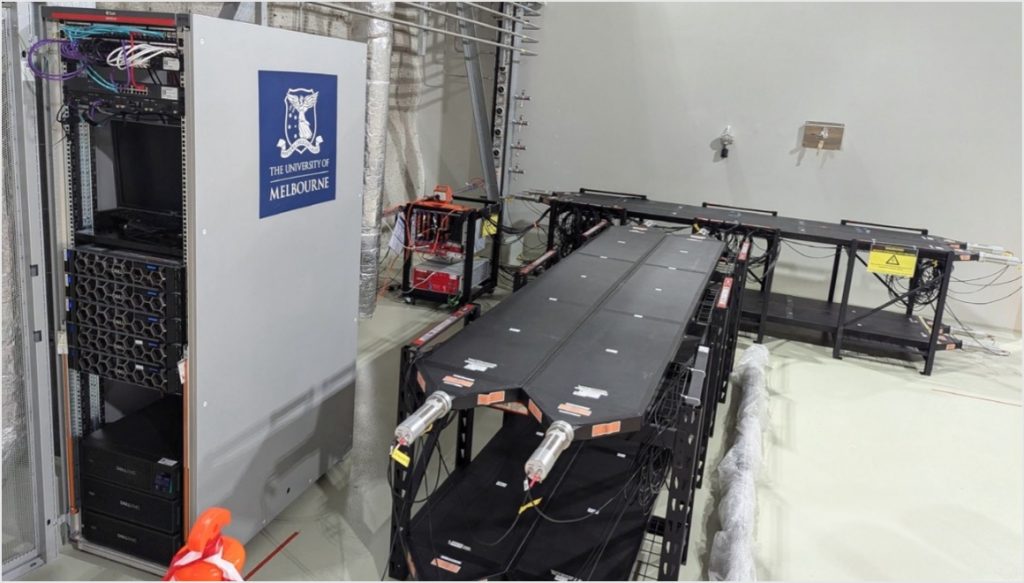
The SABRE South detector is located 1,024 meters underground at the Stawell Underground Physics Laboratory (SUPL) in Australia, with a shielding equivalent to 2,900 meters of water to reduce cosmic radiation. It uses ultra-high-purity sodium iodide (NaI(Tl)) crystals as the dark matter target. These crystals are immersed in a liquid scintillator veto system that surrounds the active region to further reduce background radiation. The detector is designed to identify the scintillation light produced when dark matter particles potentially interact with the crystal nuclei, providing a highly sensitive means of searching for annual modulations in dark matter signals.
The data acquisition system for the SABRE South experiment includes V1730 CAEN (500 MS/s, 14-bit) digitizers and V1743 CAEN digitizers (3.2 GS/s, 12-bit). The V1730 digitizers are responsible for recording signals from the 20.4 cm Hamamatsu R5912 PMTs submerged in liquid scintillator, which tags and vetoes intrinsic backgrounds. Meanwhile, the V1743 digitizers are used to sample signals from the plastic scintillator muon detector. These high-speed digitizers allow for precise timing and energy resolution, ensuring effective background rejection and particle identification in the search for dark matter